
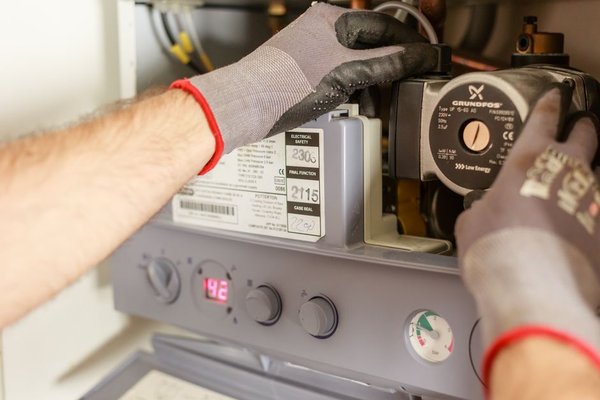
How does a combi boiler work?
A combi boiler provides central heating and hot water from one appliance. It heats water for your radiators when the heating controls call for warmth, then heats fresh mains water on demand when you open a hot tap or shower, so there is normally no separate hot water cylinder.
There are two water paths inside the system. Understanding them makes the setup easier to follow.
Definition: A combination, or combi, boiler provides both space heating and domestic hot water without a separate hot water cylinder. The heating circuit recirculates water through the boiler and radiators, while fresh cold water for taps comes from the mains and is heated when needed.
How does a combi boiler heat water?
For central heating, the boiler responds to controls such as a thermostat or programmer and heats water circulating around the radiator circuit. For taps and showers, it detects a hot-water demand and heats incoming cold water as it passes through the appliance.
Heat produced by burning gas is transferred into water through a heat exchanger arrangement. The internal layout varies between boiler designs, but the principle is the same: useful heat passes into the water without combustion gases mixing with it.
Heating water and tap water are separate
The water travelling through your radiators is part of a closed heating circuit. It leaves the boiler hot, gives up heat around the home, then returns cooler to be heated again.
Domestic hot water is different. When you open a tap, fresh cold water enters from the supply, is heated by the boiler and travels to the outlet. It is not the same water circulating through the radiators.
Does a combi boiler need a hot water tank?
No. A standard combi heats hot water on demand, so it does not need the separate cylinder used with a system or regular boiler. That can free up cupboard space and simplify the arrangement.
The trade-off is that there is no large stored reserve of heated water. A home with several bathrooms or frequent simultaneous demand may therefore need a different setup. If you are choosing between layouts, combi boiler vs system boiler is the useful comparison to make.
For a broader buying checklist, see Best Combi Boilers for UK Homes: What to Compare Before You Buy. The right choice depends on the property and its hot-water demand, not simply on which boiler is more compact.
Can a combi boiler run heating and hot water together?
A combi provides both services, but it does not normally give radiators and a hot tap equal priority at the same moment. When a hot-water outlet is opened, the boiler typically prioritises domestic hot water.
The central-heating side can therefore pause while someone showers or runs a hot tap. Once that demand ends, the boiler returns to heating if the controls still call for heat. A short interruption may barely be noticeable because radiators and the building retain warmth.
Why this matters when choosing a boiler
Hot-water demand is one reason combi boiler size must be matched to the home rather than chosen from floor area alone. The boiler needs to suit the heating requirement and the way the household actually uses bathrooms and taps.
Where does a combi boiler get its water from?
The domestic hot-water side is supplied directly from the cold mains water entering the property. Because the boiler heats this water on demand, the quality of the incoming supply affects what you experience at taps and showers.
Good static pressure does not automatically mean strong performance everywhere. Available flow can change when several outlets are used at once, and the incoming main can be a limiting factor. An installer should assess the actual supply before deciding whether a combi is suitable.
The heating circuit is separate. Its water circulates repeatedly between the boiler and radiators. The pressure shown on the boiler’s heating-system gauge therefore relates to that sealed circuit, not directly to the pressure of the water coming from a tap.
Installation, repair or other gas work on a gas combi boiler must be carried out by a suitably qualified Gas Safe registered engineer; do not open the appliance or attempt internal gas work yourself.
When is a combi boiler not the right choice?
A combi is a poor fit when a household regularly needs strong hot-water delivery at several outlets at once. Because hot water is produced on demand rather than drawn from a large cylinder, busy multi-bathroom homes may find that simultaneous showers, baths and taps place too much demand on one appliance.
It is also a weak choice where the incoming mains supply cannot provide adequate flow under real conditions. Fitting a larger boiler does not fix a restricted water main. If the supply drops noticeably when other cold outlets are used, that needs to be assessed before deciding on a combi.
Do not replace a suitable cylinder-based system just because a combi looks tidier on paper. If stored hot water already matches the household’s routines, or several people need hot water at the same time, a system boiler may be the more practical arrangement despite needing cylinder space in your home.
Frequently asked questions
Why does hot water flow change when another tap is opened?
A combi depends on the available mains supply. When several outlets draw water at once, the available flow is shared, so performance at a shower or hot tap may change.
Does the boiler pressure gauge show my tap-water pressure?
Usually not. The gauge normally refers to the sealed central-heating circuit, while tap and shower performance depends on the incoming mains supply and plumbing arrangement.
Why do my radiators pause when I use a hot tap?
Combi boilers typically give domestic hot water priority. The boiler can temporarily divert its output away from the radiator circuit, then return to heating after the hot-water demand stops.
Is a combi boiler suitable for a home with two bathrooms?
It can be, but suitability depends on how often both bathrooms need hot water together and on the incoming mains supply. A proper assessment should consider simultaneous demand rather than bathroom count alone.
A combi boiler is easiest to understand as two jobs in one appliance: it recirculates heated water through the central-heating circuit and heats fresh mains water when you ask for hot water. With suitable mains flow and manageable simultaneous demand, that arrangement is compact and straightforward.