
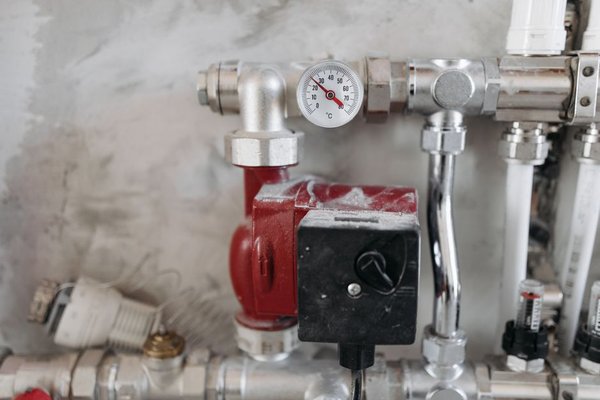
What does central heating pumps explained mean in practice?
Central heating pumps explained simply means understanding three linked settings: flow is how much water the pump moves, head is the resistance it can overcome, and speed controls how hard it works. The correct setting gives enough circulation for every radiator without creating unnecessary noise, electrical use or excessive water velocity.
A heating pump does not make heat. It moves heated water from the boiler through the pipework and radiators, then back again, so its job is to provide the flow the system needs against the resistance of valves, fittings and pipes.
The electricity figure above uses the 40 W maximum input of a Wilo Yonos PICO 25/1-6 as a concrete example, not a claim that every pump always draws 40 W. The hourly working is 40 W ÷ 1,000 = 0.04 kW, then 0.04 kW × 1 hour × 26.11p/kWh = 1.04p. For the annual figure, the assumption is 8 hours a day for 180 heating days: 0.04 kW × 8 × 180 × £0.2611 = £15.04.
Definition: A central heating circulator is a small electric pump that keeps hot water moving around a closed heating circuit. Flow rate tells you how much water it moves, while pump head describes the pressure difference available to push that water through system resistance.
For a specific central heating pump, start with its nameplate or manual. The useful figures are normally maximum head in metres, flow in cubic metres per hour, electrical input in watts and the available control modes.
What is flow rate in a central heating pump?
Flow rate is the volume of water passing through the heating circuit in a given time. It is usually shown as cubic metres per hour, litres per hour or litres per minute, and the system needs enough flow to carry heat from the boiler to the radiators.
A published maximum flow figure is only one edge of a pump curve. Wilo lists a maximum flow of 3.6 m³/h for the Yonos PICO 25/1-6, equal to 60 litres per minute, but that does not occur at the same operating point as its 6 m maximum head. Real operation sits on the curve where flow and head meet the resistance of the installed system.
This is why central heating pump sizing should be based on a duty point rather than simply choosing the largest numbers. A central heating pump sizing calculator can help organise the flow and head inputs, but the result still needs to match the actual pipework and controls.
What does pump head mean in a domestic heating system?
Pump head expresses the pressure difference the circulator can produce, normally in metres of water. In a closed central-heating circuit it is mainly about overcoming friction through pipes, bends, valves and radiators, not lifting water to the physical height of the top radiator.
A pump marked with a 6 m maximum head is therefore not limited to a six-metre-tall house. The correct duty point combines the required flow with the head needed at that flow, which is why reading only the maximum-head number can lead to the wrong selection.
If a system that used to work properly suddenly needs a much higher setting, treat that as a symptom rather than proof the pump is too small. Air, sludge, a sticking valve or another central heating pump problems issue can change circulation and should be checked first.
Why do central heating pumps have different speed settings?
Different speed settings let the pump match its output to the resistance and flow demand of the heating circuit. Older circulators often offer three fixed speeds, while modern electronic models may provide proportional-pressure, constant-pressure or constant-speed modes.
- Constant speed: follows one selected pump curve.
- Proportional pressure: reduces the pressure target as flow demand falls, which can suit radiator systems with thermostatic valves.
- Constant pressure: aims to maintain a set differential pressure as flow changes.
The right central heating pump speed is the lowest setting or control curve that still delivers the required circulation across the whole system. Turning a pump to maximum can mask poor balancing without correcting the distribution problem.
How does pump speed affect radiator heating?
Pump speed affects how quickly water circulates and how much pressure is available to move it through the radiator circuit. If the setting is below what the system requires, some radiators can warm slowly; if it is higher than required, valve and pipe noise can become more noticeable without making the boiler produce more heat.
A cold radiator is not automatically a pump-speed fault. Check whether it needs bleeding, whether its valves are open, whether other radiators are taking too much flow and whether the system is properly balanced.
Increasing speed can improve circulation where the previous setting genuinely could not meet the duty point. It can also reduce the temperature difference between flow and return because water moves through the emitters more quickly, so blindly choosing the highest setting is poor practice.
If changing the setting creates rushing or whistling sounds, follow the manufacturer instructions. Persistent central heating pump noise can come from excess differential pressure, air, cavitation or worn components rather than the speed selector alone.
What is the difference between fixed-speed and variable-speed pumps?
A fixed-speed pump runs on a manually selected constant curve. A variable-speed pump uses electronic control to alter its output as system demand changes, with the exact behaviour depending on the selected mode.
| Operating point | Fixed-speed pump | Variable-speed pump |
|---|---|---|
| Basic control | Runs on one selected speed or curve | Adjusts output electronically within the chosen mode |
| When TRVs close | Continues on the selected fixed curve | Can reduce output as demand changes |
| Adjustment | Often has two or three speed levels | May offer proportional pressure, constant pressure and constant-speed curves |
| Electrical input | Depends on the model and selected speed | Can fall below maximum input when lower output is required |
| Commissioning | Needs the correct fixed setting | Still needs a suitable mode and setpoint; automatic control does not replace balancing |
Modern circulation pumps for central heating are often electronically controlled, but the pump curve, radiator valves, zoning arrangement and heat-source requirements still matter. If the circulator is built into a gas boiler, diagnosis or replacement that requires access to the appliance should be carried out by a Gas Safe registered engineer.
When does changing the pump setting not solve the heating problem?
Changing the pump setting does not fix a system that is dirty, full of air, badly balanced, restricted by a stuck valve or controlled incorrectly. A higher speed may make one cold radiator feel better for a short time while creating rushing water elsewhere. That is not a repair; it is moving the symptom.
It is also not a sensible DIY experiment if the pump is inside a gas boiler, if the controls are unfamiliar, or if changing settings would conflict with the appliance instructions. Access to gas-appliance internals belongs with a Gas Safe registered engineer. In a rented home, report a heating fault to the landlord or managing agent rather than altering equipment you are not authorised to adjust.
The neat online fix of “turn the pump to speed three” only works in a photograph where pipe resistance, balancing, sludge and control behaviour are invisible. If the system worked on the existing setting before and has recently deteriorated, find the fault first. If it has never heated evenly, balancing and proper pump selection are more useful than repeatedly increasing speed.
Frequently asked questions
Should a central heating pump run all the time?
Not necessarily. Many boiler systems run the circulator only when there is heat demand, sometimes with a short overrun after the burner stops. If yours runs continuously with no heating requested, check the controls or manufacturer instructions.
How can I tell if my pump setting is too high?
Rushing water or whistling thermostatic valves can point to excessive differential pressure, although other faults can cause similar symptoms. Check balancing, valve condition and air in the circuit before blaming the pump setting.
Does a 6 m pump head mean the pump can only serve a six-metre-high house?
No. In a closed heating circuit, pump head is mainly the pressure difference available to overcome flow resistance, not the height from the boiler to the top radiator. Selection should be based on the required duty point.
Can I change the pump speed myself?
If the manufacturer provides an external user control and permits adjustment, follow those instructions exactly. Do not open a gas boiler or access gas-appliance components; that work should be handled by a Gas Safe registered engineer.
Does a larger pump always heat radiators better?
No. A pump needs to match the system’s required flow and head, not simply have the highest maximum figures. An unnecessarily high setting can increase water velocity and noise while leaving balancing or restriction faults unresolved.
With central heating pumps explained in terms of flow, head and control mode, the useful question is not “what is the highest setting?” but “what duty does this system actually need?” Start from the pump curve and the condition of the circuit, use the lowest suitable setting, and treat sudden changes in performance as a fault to diagnose.