
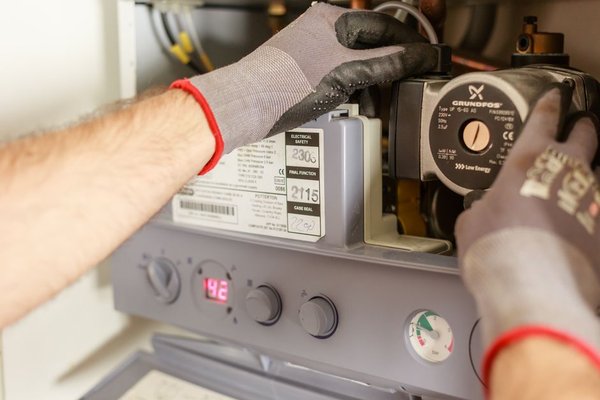
What does a central heating circulating pump do?
A central heating circulating pump moves heated water from the boiler through the pipework and radiators, then returns cooler water to be reheated. If circulation is weak or stops, some radiators may stay cold even while the boiler fires. Safe checks include controls, radiator valves, pressure and obvious system symptoms.
The pump is a small but essential part of a wet central-heating system. When it is working properly, you rarely notice it; when circulation goes wrong, cold radiators, uneven heat or unusual noise can make the fault much more obvious.
Definition: A central heating circulation pump is an electrically powered circulator that keeps hot water moving around a closed heating circuit. It does not create the heat itself. The boiler heats the water; the pump provides the flow needed to carry that heat to radiators or other emitters and back again.
For the electricity example above, the assumed pump input is 30 W, with the pump operating for 8 hours a day on 180 heating days a year. The working is 30 W ÷ 1,000 = 0.03 kW; 0.03 kW × 8 hours × 180 days = 43.2 kWh; 43.2 kWh × £0.2611 per kWh = £11.28 a year. Your own figure will change with the pump’s actual wattage, control mode and hours of operation.
If you are trying to understand the whole component rather than one symptom, start with central heating pump. Modern circulation pumps for central heating may vary their speed automatically, while older units can use fixed speed settings.
How does a circulating pump move water around a heating system?
The pump uses a small electric motor and impeller to create flow through the heating circuit. That flow carries hot water away from the boiler and pushes returning water back towards it, allowing heat to be distributed around the home.
The boiler raises the water temperature, the pump sends it through the flow pipe, and radiator valves control individual emitters. The water releases heat, cools and returns to the boiler.
Pump behaviour also depends on demand from the programmer, room thermostat, boiler control or zone valve. A pump that seems inactive is not automatically faulty; the controls may simply not be asking it to run.
What are the signs of poor circulation from a heating pump?
Poor circulation often shows up as uneven heating rather than a completely dead system. You may find that radiators near the boiler warm first while distant radiators remain cool, or that the boiler heats rapidly but useful warmth is slow to reach rooms.
- Several radiators stay cool despite the heating being on long enough to warm the system.
- Upstairs and downstairs heat very differently without an obvious control reason.
- The boiler cycles on and off quickly while rooms remain cold.
- Pipework is hot close to the boiler but noticeably cooler farther around the circuit.
- The pump area produces persistent humming, rattling or grinding rather than a faint operating sound.
These symptoms are not proof of a failed pump. Air in radiators, closed thermostatic radiator valves, sludge, a stuck zone valve, incorrect balancing or a control fault can create similar results. If noise is the main clue, central heating pump noise is a better route for separating normal operating sound from a fault symptom.
Walk around the home and note which radiators heat, which do not, and whether their valves are open. That pattern is useful information for an engineer.
Can a circulating pump run while radiators stay cold?
Yes. A pump can be electrically running but still fail to deliver enough useful flow, and a perfectly healthy pump can also be running while another part of the system prevents hot water reaching the radiators.
Start with checks that do not involve opening the boiler case or electrical covers. Confirm that the programmer is on, the room thermostat is calling for heat, radiator valves are open, and the boiler display shows no fault code. On a sealed system, compare the visible pressure gauge with the range stated in the boiler manual.
If only one radiator is cold, the pump is less likely to be the sole cause because water is reaching elsewhere. If nearly every radiator stays cold while the boiler fires, a wider circulation or control problem is more plausible. Persistent symptoms belong under central heating pump problems.
How do you tell if a heating pump is airlocked?
An airlocked pump may make a rushing, gurgling or irregular sound and may circulate water poorly even though the motor is trying to run. However, those symptoms are not unique to trapped air, so sound alone cannot confirm the diagnosis.
Air elsewhere can cause similar trouble. A radiator that is cool at the top but warmer lower down commonly points towards trapped air in that radiator. If you know how to bleed a radiator safely and the manufacturer permits it, follow the appliance instructions and recheck system pressure afterwards.
Do not loosen electrical pump parts, remove the pump head or open a boiler casing to test for air. Water and mains electricity are close together. A central heating circulator pump inside a boiler should be assessed under the manufacturer’s service instructions, not dismantled as a household check.
When does a circulating pump need professional attention?
Professional attention is sensible when basic checks do not restore circulation, when the pump leaks or repeatedly stops, or when there is grinding, severe vibration, a burning smell or an electrical fault. Boiler internals, wiring and gas-appliance components are not DIY diagnosis jobs.
Gas work on a gas boiler must be carried out by a Gas Safe registered engineer. Electrical fault-finding should be handled by a suitably competent professional, particularly where testing requires exposed live parts or isolation of fixed wiring.
Call for help rather than continuing to experiment if any of these apply:
- Water is leaking from the pump body, its connections or the boiler.
- The heating repeatedly trips an electrical protective device.
- The pump becomes unusually hot, smells burnt or makes harsh mechanical noise.
- The boiler displays a fault that returns after the user-reset procedure in its manual.
- Several safe checks point to poor circulation but the cause is still unclear.
If the issue is simply that heat moves around the system too aggressively or too slowly, a professional may also check central heating pump speed, system balancing and whether the installed circulator is appropriate for the resistance of the circuit.
When do these checks not solve a circulation problem?
They do not solve a fault that sits behind a boiler casing, inside fixed wiring, in a seized pump, in a failed motor, in a stuck motorised valve or in badly restricted pipework. Looking at the thermostat, opening radiator valves and checking a visible pressure gauge can rule out simple causes, but those checks cannot prove that the pump itself is healthy. A pump may hum and still move too little water; it may also be perfectly sound while sludge or a control fault blocks useful circulation.
In a rented home, do not dismantle heating equipment or authorise alterations that belong to the landlord. Report the symptoms and use the normal repair route. If the boiler or pump is under warranty, unauthorised work can also create a separate warranty problem. Photographs of a display, pressure gauge or visible leak can help document the fault, but a photograph cannot show electrical continuity, internal pump condition or actual system flow. If diagnosis requires covers to come off, wiring to be tested or gas-boiler components to be disturbed, that is where household checking ends.
Frequently asked questions
Should a heating pump run all the time?
Not necessarily. Pump operation depends on the boiler, system design and controls, so it may run only during a heat demand and sometimes for a short overrun period afterwards. Check the boiler or control manual if you want to know what is normal for your installation.
Is a warm central-heating pump normal?
A pump can feel warm because it contains an electric motor and is surrounded by hot heating water. Excessive heat combined with harsh noise, a burning smell, repeated stopping or electrical trips is different and warrants professional attention.
Can one cold radiator mean the pump has failed?
Usually not by itself. If other radiators heat normally, water is circulating somewhere in the system, so a closed valve, trapped air, balancing issue or local blockage may be more likely than total pump failure.
Does bleeding radiators affect boiler pressure?
On a sealed system it can, because releasing air may also reduce system pressure. Follow the boiler manufacturer’s instructions and use its stated pressure range rather than topping up to an assumed figure.
How much electricity does a 30 W heating pump use?
At 30 W, one hour of operation uses 0.03 kWh. At 26.11p/kWh for the July to September 2026 Ofgem cap period, that is about 0.78p per hour; at 8 hours a day for 180 heating days, the same assumption gives 43.2 kWh and £11.28 a year.
A central heating circulating pump is only one part of the heating circuit, so the pattern of symptoms matters more than one noise or one cold radiator. Check controls, valves, visible pressure and radiator behaviour first; if circulation remains poor or the job moves into boiler internals, fixed electrics or leaking components, bring in the appropriate professional.