
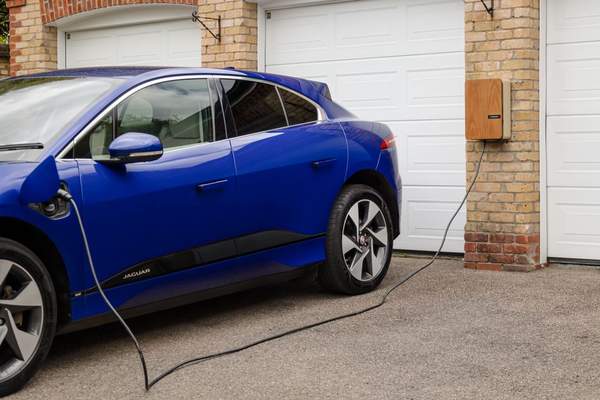
How should an ev charging cable 10m be routed safely?
An ev charging cable 10m should follow the edge of the driveway or a wall wherever possible, with the connector ends kept off the ground and the cable kept out of vehicle paths. If it must cross a walking route, use a suitable cable protector and remove or store the cable after charging.
A 10-metre lead gives useful reach when the wallbox and parking space are not close together, but the extra length needs deliberate routing. Keep as much cable as possible beside a wall, fence or driveway edge rather than across the route people use.
The annual figure assumes a 7.4 kW wallbox charging at full power for 1 hour a day, 365 days a year. The working is 7,400 W divided by 1,000 = 7.4 kW; 7.4 kW × 1 hour × 24.5p/kWh = 181.3p for that hour, and 181.3p × 365 = £661.75, rounded to £662 a year at 24.5p/kWh for the July 2026 cap period. Actual use depends on the kWh the car needs, not the cable length.
How should a 10 m EV cable be routed across a driveway?
Keep the cable away from the part of the driveway where tyres, feet, bins and bikes normally pass. A route around the perimeter is better than the shortest straight line if it prevents the lead being driven over or stretched across a doorway.
Look at the fixed charger position and the car’s charge port. A ev charging cable needs enough slack to reach the vehicle without being pulled tight, but not so much that loops spread into the walking area.
- Plan the edge route: Trace a path beside a wall, fence, hedge or driveway boundary before you plug in, rather than laying the cable diagonally across open paving.
- Leave controlled slack: Keep gentle slack near the vehicle so the plug is not carrying tension, while avoiding large coils on the ground.
- Protect unavoidable crossings: If the cable must cross a pedestrian route, cover that section with a purpose-made protector suitable for the cable and location.
- Keep connectors clear: Do not leave a disconnected connector lying in a puddle, gutter or muddy area.
- Check the route before charging: Make sure gates, garage doors and car doors will not pinch the cable and that no vehicle needs to drive over it.
- Store it after use: Once charging is finished and the equipment is disconnected as the manufacturer instructs, put the cable on its holder or in suitable storage.
A 10m ev charging cable can suit offset parking, but that does not make every 10-metre route sensible. If the lead only reaches by crossing a public pavement or shared access route, the problem is the location, not the amount of slack. Moving fixed charging equipment may need an electrician or the property owner’s approval.
Can a 10 m charging cable be left outside in the rain?
Many EV charging cables are designed for outdoor use, but follow the exact manufacturer’s instructions and check the cable, plugs and protective caps for your model. Outdoor-rated does not mean a disconnected connector should sit in standing water or damaged insulation can be ignored.
Rain is only part of the exposure. Water around a dropped connector, grit in the plug and a cable trapped under a gate or wheel can all cause problems.
- Keep disconnected connector ends capped or stored as the manufacturer specifies.
- Do not use a cable with cuts, crushed sections, exposed conductors or damaged plug housings.
- Keep the lead away from drains, deep puddles and places where water routinely pools.
- Do not improvise waterproofing with bags, tape or homemade covers around live charging connections.
If you use a ev charging cable storage box, position it where the cable can be put away without dragging a wet connector through dirt. The box should suit its location and should not force the cable into a tight bend.
How can I stop a long charging cable becoming a trip hazard?
Treat the walking route as the priority and route the lead around it rather than expecting people to step over it. The best result is a cable that remains visible, lies flat where it has to cross, and spends as little distance as possible in the pedestrian area.
A long ev charging cable can become awkward because spare length forms loops. Do not solve that by pulling the lead tight between the wallbox and car; instead, place spare length in a controlled loop beside the charger or on a suitable holder, within the manufacturer’s bend guidance.
Where a crossing cannot be avoided, use a purpose-made cable protector that fits the cable and sits stably on the surface. A loose rubber mat, timber strip or carpet may look tidy in a photograph, but it can create a new raised edge, shift underfoot or trap water. The protection should reduce the change in level and make the crossing obvious rather than hiding it.
If children, visitors or delivery drivers use the same route, assume they will not know a cable is there. Route it so someone looking ahead rather than at the ground is unlikely to meet a loose loop.
What storage setup works best for a 10 m cable?
A wall-mounted holder close to the charger usually keeps a long lead controlled without forcing it into a small container. The aim is to support the cable in broad loops, protect the connectors and make it easy to put away every time.
An ev charging cable holder should be placed where the stored cable does not hang into a doorway, rub against a sharp edge or sit where a parked car can trap it. For a 10 meter ev charging cable, storage needs enough space for several relaxed loops rather than one tight coil.
How should the cable sit on its holder?
Use a holder that supports broad loops and follows the manufacturer’s storage instructions. Keep the stored lead away from mud and garden debris, and do not stuff it into a small space while it is twisted.
Before hanging the cable, remove twists by laying out enough length to let it relax. Coil it in the same natural direction each time and avoid tight bends near the plug ends. If it repeatedly springs off the holder, the holder is probably too small for the cable’s length or stiffness.
When does neat driveway cable routing not work?
Sometimes there is no genuinely tidy route. In a rented home, you may not be allowed to fix a holder to an exterior wall, drill through a surface or move charging equipment without the landlord’s permission. In a flat or terraced property, the only path to the car may cross a communal route or public pavement, where simply laying out a cable is not a responsible answer.
The photographs that show a perfectly straight lead across an empty drive also ignore bins, children, visitors, gates and the fact that cars do not park in exactly the same position every time. A cable protector can reduce the trip risk at a necessary crossing, but it does not turn a poor route into a good one. If the cable must cross a shared access route for most of its length, or be driven over to reach the charge port, reconsider the charger position. Any alteration to fixed electrical equipment should be handled by a competent electrician, and tenancy, warranty and property rules still apply.
Frequently asked questions
Is a 10 m EV cable too long for home charging?
No, if the extra reach solves a real parking-distance problem and the spare length can be stored safely. A longer cable is less convenient if most of it sits in loose coils on the ground every time you charge.
Does a longer EV cable use more electricity?
The cable length does not change the household charging calculation used here: charging energy is measured in kWh delivered through the charger. For a 7.4 kW charge lasting 1 hour, the example cost is 181.3p at 24.5p/kWh for the July 2026 cap period.
Can I run an EV cable under a garage door?
Only if the door and cable arrangement is specifically designed to avoid crushing, cutting or trapping the lead. If closing the door presses on the cable, change the route rather than relying on the cable jacket to take the load.
Should I coil an EV cable while the car is charging?
Follow the cable and charger manufacturer’s instructions. Avoid tightly coiling spare cable or creating compact loops simply to make the driveway look neat; use the intended storage or cable-management arrangement instead.
Can I use a normal extension lead with an EV charger?
Do not assume a household extension lead is suitable for EV charging. Use the charging equipment and connection method specified by the vehicle and charger manufacturers, and ask a competent electrician if the fixed supply or socket arrangement needs changing.
The safest use of an ev charging cable 10m is not about making the cable disappear; it is about giving it a predictable route that people and vehicles do not need to cross. Plan the edge route first, protect only the crossings you cannot avoid, and store the full length properly once charging is finished.