
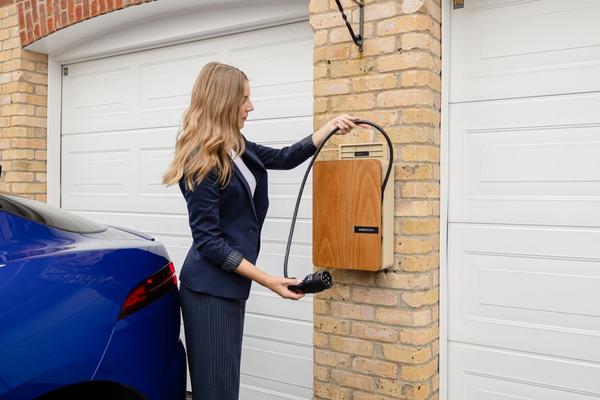
What is an ev smart charging station?
An ev smart charging station is a home EV charger that can control when charging starts, pause or resume a session, respond to tariff timing and manage demand on the household supply. It still delivers electricity to the car, but software adds scheduling, monitoring and load-control functions around the charging process.
A smart home charger is mainly about control over timing and power demand, not about changing how much energy the battery ultimately needs. The practical questions are timing, household load and usable data.
Definition: An ev smart charging station is a connected home charging point that can schedule charging, react to tariff timing, report charging activity and manage how the charger uses the available household electrical supply.
The £662 annual figure assumes a 7,400 W wallbox charging for one hour a day, every day for 365 days. The working is 7,400 W ÷ 1,000 = 7.4 kW; 7.4 kW × 1 hour × 24.5p/kWh = 181.3p for that hour; 181.3p × 365 = £661.75, rounded to £662 a year at 24.5p/kWh for the July 2026 cap period. Change either input and the result changes.
For the wider context around home ev charging stations, the smart part sits on top of the basic charging function. If you want the underlying electrical process first, how do ev charging stations work covers that wider question.
What makes an EV charging station smart?
A charger becomes smart when it can make or follow decisions about charging rather than simply supplying power whenever the cable is connected. That means controls for timing, charging status and household load, with information passed between the charger, its software and the user.
The important distinction is control. A basic charging point supplies electricity; a smart unit can hold a session until a chosen period, change its behaviour according to a schedule and show what the charging session is doing. It does not create energy or reduce the battery’s energy requirement.
Smart does not mean fully automatic
The user still needs sensible rules. A schedule only helps if it leaves enough time for the car to reach the required charge before the next journey, and tariff-linked timing only makes sense when the household tariff actually has different periods to respond to.
This is where ev charging station monitoring matters. Monitoring gives the bill payer a record of what the charger did instead of leaving the session as an invisible household load. The useful categories are simple: charging status, scheduled times, energy used and any load-control activity.
How can smart charging shift charging to cheaper periods?
Smart charging can delay the start of a session until a time window chosen by the user or allowed by the tariff settings. The charger then supplies power during that scheduled period instead of beginning immediately when the car is plugged in.
The charger is shifting timing, not changing the basic calculation for energy used. If a 7.4 kW wallbox charges for one hour, the energy for that hour is still 7.4 kWh; the monetary result depends on the unit rate that applies during that hour.
Use the tariff rate that actually applies
The calculation is always the same: charger wattage divided by 1,000, multiplied by charging hours, multiplied by the unit rate in pence per kWh. Using the July 2026 cap assumption in this brief, 7,400 W ÷ 1,000 × 1 hour × 24.5p/kWh = 181.3p for one hour. If your tariff uses another rate during the scheduled period, substitute that published rate rather than reusing 24.5p/kWh.
A smart charger therefore lets you place the session into a chosen tariff period, but the bill result still depends on the tariff’s actual unit rate and the number of charging hours. The schedule also needs to leave the car connected long enough to complete the planned charge.
The same scheduling idea appears in workplace ev charging stations, although a home charger is managing one household supply rather than a wider charging site.
Can a smart charger reduce the load on a home supply?
A smart charger can manage its own demand when the system supports load management, reducing or delaying charging when the household supply is already carrying other demand. It does not increase the capacity of the home’s electrical supply; it manages when the charger uses the capacity that is available.
This matters because a 7.4 kW wallbox is a substantial household load. Smart control can stop the charger behaving as though it is the only electrical demand in the property.
Load management is a control function, not extra capacity
Load management is a rule about priority. The charger can reduce its charging demand when the home’s available supply is constrained, then increase charging again when more capacity is available. The exact behaviour depends on the charger and installation, so do not assume every product applies the same control logic.
Electrical installation work should be assessed and carried out by a suitably qualified person. Smart controls do not replace a correctly designed home charging installation or remove the limits of the existing supply.
If you are planning the physical work, install ev charging station is the relevant next topic. The broader ev charging stations hub covers the other parts of choosing and using a home charging point.
What data and controls does a smart EV charger usually provide?
A smart charger usually centres its information on the charging session: whether the car is charging, when the session is scheduled and how much energy the charger has supplied. Controls then let the user change timing or stop and restart the session within the functions supported by that charger.
For a bill payer, useful information is information that can be checked. A session total in kWh can be multiplied by the applicable p/kWh rate, while a schedule can be compared with the tariff period the household intended to use.
What to look for in the charging record
- Charging status: whether a session is waiting, active, paused or complete.
- Scheduled times: when the charger is set to begin or stop supplying power.
- Energy used: the kWh recorded for a session or period, which can be checked against the household tariff rate.
- Load-control activity: whether charging demand was reduced or delayed because the household supply needed capacity elsewhere.
These records are the practical side of ev charging station monitoring. They let you check whether the charger operated at the time and power pattern intended. Do not treat an app screen as the whole household bill: the charger records its own activity, while the electricity meter covers the home as a whole.
When does a smart EV charging setup not work well?
A smart charger is not automatically useful in every home. In a rented property, the tenant may not control whether a wallbox can be installed, where it can be fixed or what electrical work the landlord will permit. In a flat, a private parking space and a practical cable route may be the real constraint. A photograph of a neat wallbox beside a driveway does not solve shared parking, a distant meter position or a landlord who has not agreed to the work.
Smart scheduling is also weak if the household tariff gives no useful time-based reason to move the session, or if the car is connected for too short a period to follow the chosen schedule. Load management cannot create extra electrical capacity; it can only control the charger’s demand within the supply that exists. If the installation itself is unsuitable, software does not make it suitable. Treat the smart functions as controls around a correctly planned charging installation, not as a substitute for one.
Frequently asked questions
Does a smart charger use less electricity to put the same energy into the car?
Smart charging mainly changes timing and control. The battery still needs the required amount of energy, so use the charger’s recorded kWh and the unit rate that applied during the charging period to work out the charging cost.
Can I plug the car in before the scheduled charging time?
Yes, a smart schedule can be set so the car is connected before charging begins. The vehicle stays available to the charger while the software waits for the chosen charging window.
What happens if I need the car earlier than planned?
The schedule needs to match the next journey. If the charger supports manual control, the user can change the planned session, although doing so may move charging outside the period originally chosen.
Is charger monitoring the same as the electricity meter?
No. Charger monitoring records the charger’s own sessions, while the household electricity meter records the property’s total electricity use. Use the charger’s kWh data for charging activity and the household meter or bill for the wider home total.
Does smart load management increase my home’s electrical capacity?
No. Load management controls the charger’s demand within the capacity available to the property. It can reduce or delay charging demand, but it does not turn the existing supply into a higher-capacity supply.
A smart home charging point is useful when its controls match the way the car, tariff and household supply are actually used. Judge it by checkable behaviour: when it charged, how many kWh it delivered and whether its schedule and load controls did what you intended.