
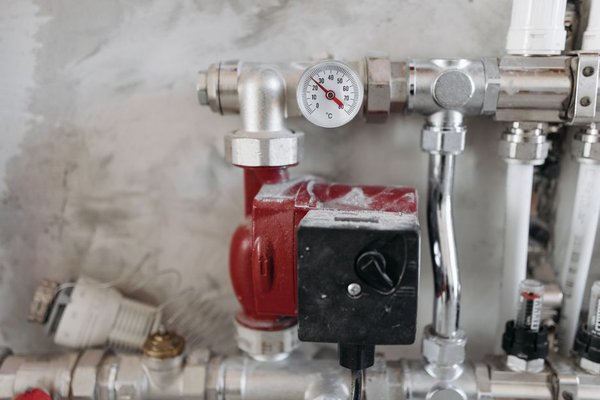
How do I choose a domestic central heating pump replacement?
Choose a domestic central heating pump that matches the existing pipe connection size, installation length, electrical supply and required flow and head. Check whether the heating circuit needs fixed-speed or variable-speed control, and whether the pump is separate from the boiler. Have a competent heating professional confirm compatibility before fitting it.
A pump can look identical to the old one yet have the wrong performance curve or connections. The useful comparison starts with the existing model label, the heating layout and the settings the installer expects the new unit to maintain.
What type of pump is used in a domestic central heating system?
Most wet central heating systems use an electrically powered circulator that moves heated water around radiators or underfloor pipework. Some boilers contain an integrated pump; other systems have a separate unit in the pipework, so the correct replacement depends on where it sits and how the boiler controls it.
Start with the existing arrangement
Common circulation pumps for central heating use a wet-rotor design, with water helping to lubricate internal components. Older installations may have a manually selected speed, while modern high-efficiency models can alter their output as valves open and close. Neither description tells you the exact replacement without a model number and system check.
For a plain explanation of how circulation fits into the complete heating circuit, see central heating pump. The distinction between an external circulator and a boiler-integrated assembly matters more than whether the front of the unit has a display.
How do you match a replacement pump to existing pipe connections?
Match the port-to-port installation length, union or threaded connection size and permitted mounting orientation before considering controls. A pump sold for the right heating application can still require unsuitable pipe alterations if those dimensions differ from the old assembly.
Measure the fit, not just the pipe diameter
Common replacement ranges include 130 mm and 180 mm installation lengths, but those figures are product dimensions, not guarantees of compatibility. Ask the installer to check the distance between mating connections, the actual thread or union specification, clearance around the motor and whether existing isolation valves operate properly.
Where the heating pump is part of a gas boiler, use the boiler manufacturer’s approved replacement route. Work on gas appliances that falls within gas work must be carried out by a Gas Safe registered engineer; electrical connection work also needs an appropriately competent professional. A shop description saying ‘universal’ does not override those requirements.
Do variable-speed pumps suit older heating systems?
They often do, especially where thermostatic radiator valves change the amount of water the system needs, but age alone does not decide suitability. An installer must check minimum circulation requirements, bypass arrangements and the pump curve against the existing boiler and pipework before changing control strategy.
| Pump detail | Fixed-speed circulator | Variable-speed ECM circulator |
|---|---|---|
| Motor control | Runs on one selected fixed-speed curve | Adjusts output according to selected control mode |
| Radiators with TRVs | May need careful balancing and bypass provision | Proportional-pressure mode may suit changing demand |
| One-pipe or constant-flow circuits | A fixed curve can suit the design | May need a constant-curve or appropriate fixed setting |
| Underfloor heating | Possible where design flow is maintained | Constant-pressure control may suit the manifold arrangement |
| Displayed information | Often a simple speed selector | May show watts, head setting or faults |
| Replacement check | Match dimensions and hydraulic duty | Match dimensions, hydraulic duty and control compatibility |
If an older system has sludge, persistent cold radiators or unusual noises, a different pump cannot by itself clear the restriction. Investigate central heating pump problems before assuming the original motor was too weak.
What pump settings matter for a typical home?
The main choices are proportional pressure, constant pressure and a fixed performance curve or speed. The right setting maintains water movement through the intended circuits without excessive pressure, noise or unnecessary electrical use; it cannot be selected reliably from the house’s bedroom count.
Understand what the controls change
Proportional-pressure operation reduces available pressure as demand falls, which can suit conventional two-pipe radiator circuits with TRVs. Constant-pressure operation maintains the selected pressure over changing demand and may suit certain underfloor arrangements. A fixed curve can be appropriate where the system needs relatively steady flow. These are starting points for commissioning, not instructions to override the existing design.
During commissioning, a professional should check that distant radiators heat properly, valves behave without whistling and the boiler receives its required minimum flow. The central heating pump speed guide helps explain why turning a selector to its highest mark is not a reliable cure for a cold room.
Check electricity with a reproducible calculation
The cost block uses an illustrative 40 W draw, not a measured value or a manufacturer’s guarantee. Assume the circulator runs eight hours a day for 180 heating days: 40 W divided by 1,000 is 0.04 kW; 0.04 × 1 hour × 26.11p/kWh equals 1.0444p, rounded to 1.04p an hour. At 8 × 180 = 1,440 hours, 0.04 × 1,440 × £0.2611 equals £15.04 for that assumed year, using the July–September 2026 Ofgem average Direct Debit electricity rate in Great Britain.
For comparison, a hypothetical 70 W operating draw over the same 1,440 hours gives 0.07 × 1,440 × £0.2611 = £26.32 a year at 26.11p/kWh (July 2026 cap). The difference is £11.28 a year at that rate and use pattern. Actual electronically controlled pumps vary their wattage during operation, so use measured or displayed average power and the rate on your own bill instead of treating either example as a forecast.
Which specifications should you compare before replacing a domestic pump?
Compare physical dimensions, hydraulic performance, control modes, electrical supply and the manufacturer’s approved application. A matching-looking pump with more maximum head is not automatically a suitable upgrade, because the full flow-versus-head curve and the system’s resistance determine its behaviour.
Details to put on the installer’s quote
- Identity: existing make, model, product code and whether it is an integral boiler part.
- Connections: installation length in mm, union/thread sizes, orientation, flow direction and clearance.
- Hydraulics: specified flow in m³/h, head in metres and an appropriate operating curve.
- Controls: fixed curve, proportional or constant pressure, external signals and boiler requirements.
- Electrical and service: voltage, connection method, access, warranty terms and commissioning checks.
Proper central heating pump sizing considers heat demand, circuit flow and pressure loss together; radiator count alone is not a sizing method. A central heating pump sizing calculator may help you understand the terms, but an estimate cannot replace an installer checking the actual pipework and required duty.
When is replacing the pump the wrong solution?
A new circulator will not fix every cold radiator. If the actual fault is a stuck valve, blocked filter, airlock, poor system balance or a control that never calls for heat, replacing the motor may leave the problem unchanged. The clean new pump shown in an installation photograph proves nothing about the condition of the pipework behind it.
In a rented property, do not order or authorise work on the landlord’s heating equipment without the required agreement. In a flat with shared plant, the component may not belong to the individual dwelling at all. If the pump sits inside a gas boiler, choosing a generic external unit from its dimensions is particularly misleading: boiler approvals, wiring and safety controls matter.
Variable-speed operation is not a remedy for a badly restricted system, and the theoretical £11.28 annual electricity difference at 26.11p/kWh (July 2026 cap), assuming 1,440 hours at 70 W rather than 40 W, is not a justification for an unspecified replacement bill. Get the underlying fault diagnosed and the compatible part identified before approving work.
Frequently asked questions
Can I replace only the pump head?
Some product families permit a compatible motor-head replacement, but others require the whole assembly. Have the exact manufacturer and part numbers checked because seal, housing and electrical differences matter.
Does a larger maximum head mean better heating?
No. The pump must deliver the required flow at the system’s resistance, and excess pressure can contribute to valve noise or control problems.
Why does my pump keep making a humming noise?
Possible causes include air, vibration, worn components or unsuitable settings. A professional should distinguish normal motor sound from a circulation fault before recommending replacement.
Can I use a pump intended for drinking-water circulation?
Do not assume it is interchangeable with a sealed central heating circulator. Materials, operating temperatures, approvals and intended application differ, so check the manufacturer’s specification.
Will a new circulator make every radiator heat evenly?
Not necessarily. Balancing, trapped air, valve condition and sludge can limit circulation even when the pump itself is correctly specified.
The best replacement is the one that fits the system physically and delivers the required water flow under the right controls. Keep the existing model details and ask the installer to explain both the selected pump curve and what fault the replacement is expected to resolve.