
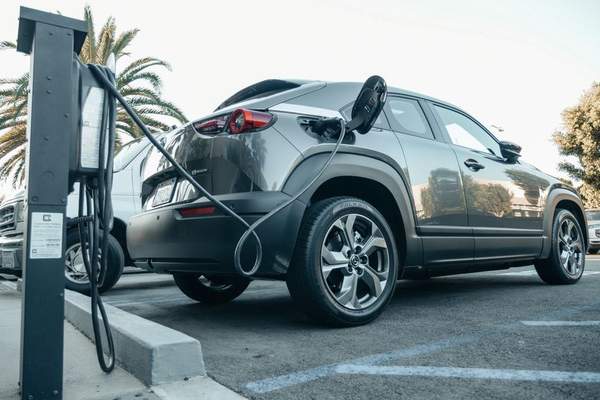
How should workplace ev charging stations be planned?
Workplace ev charging stations should be sized around how many vehicles actually need energy during the working day, not simply how many parking bays exist. Check site electrical capacity first, then decide whether chargers are dedicated or shared, use smart load management, set clear access rules and record each charging session for billing or fleet reporting.
A workplace charger is partly an electrical project and partly a parking-management system. The aim is to deliver enough energy before vehicles leave without creating queues or avoidable electrical demand.
That annual figure assumes one 7.4 kW charger delivers full power for 2 hours on each of 260 working days. The working is 7,400 W divided by 1,000 = 7.4 kW; 7.4 × 2 hours × 260 days × £0.245 per kWh = £942.76, rounded to £943 a year at 24.5p/kWh (July 2026 cap). A workplace’s actual business electricity tariff can be different, so use the same calculation with the rate shown on the site’s own bill.
How many EV charging points does a workplace need?
Start with daily energy demand, parking duration and vehicle turnover. A site where cars remain for eight hours can often serve more vehicles from fewer sockets than a depot where vans return late and must leave again early.
Count how many staff and fleet vehicles are likely to need charging on the same day, then estimate the energy each one needs before departure. If six cars each need 14 kWh, the site needs to deliver about 84 kWh across the available charging window; that matters more than simply saying there are six EVs.
For many offices, a 7.4 kW AC unit is a sensible reference point because a long parking stay gives time to add useful energy without relying on very high power. Fleet depots can be different: vehicle duty cycles, battery size and return times may justify more power, but that decision should follow a site assessment rather than a rule of thumb.
Cable routes, distribution capacity, bay layout and communications can be considered early so extra ev charging stations can be added later with less disruption.
How can workplace charging be shared fairly between staff?
Fair sharing needs a written rule that drivers can understand before they plug in. The best rule normally links access to energy need or time connected, rather than allowing the earliest arrival to occupy a bay all day.
A simple office policy might give priority to vehicles below a stated charge level, ask drivers to move after a set session, or use booking slots. A larger site can automate this with an ev smart charging station setup that identifies users, limits session length and distributes available power between active sockets.
Two common approaches are dedicated access and a shared charging pool. The comparison below shows the practical trade-off rather than treating one model as universally better.
| Workplace issue | Dedicated chargers | Shared smart charging pool |
|---|---|---|
| Who uses the socket | Assigned to a vehicle, team or named driver | Used by authorised staff or fleet vehicles under common rules |
| Parking discipline | Simple if the assigned vehicle stays in one bay | Needs booking, session limits or clear move-on rules |
| Electrical demand | Can create a higher simultaneous peak if every unit charges freely | Can divide a set power limit across several connected vehicles |
| Administration | Easy to attribute use where one vehicle matches one charger | Needs user identification and session records |
| Future growth | Extra vehicles may require more dedicated bays and hardware | Additional sockets can be easier to integrate if load management was planned from the start |
If staff pay for the energy they take, publish the method. At the article’s 24.5p/kWh July 2026 comparison rate, a measured 10 kWh session equals £2.45 at 24.5p/kWh (July 2026 cap); if the workplace uses its actual business tariff instead, state that rate and the date on every charge record.
What electrical capacity should be checked before installation?
Before hardware is chosen, an electrician should check the incoming supply, existing maximum demand, distribution boards, protective devices, cable routes and the realistic spare capacity available for charging. The answer determines whether chargers can run freely, need dynamic load management or require wider electrical work.
Do not assume that ten 7.4 kW units mean the site should permanently reserve 74 kW. Smart control can cap the combined charging load and share it between vehicles, but the cap still has to fit the site’s electrical design and the vehicles’ departure requirements.
The useful question for the contractor is not only “How many chargers can we install?” but “How much charging energy can this site reliably deliver during the hours the vehicles are parked?” That brings the electrical limit and the operational requirement into the same calculation.
- Ask for the existing site load and available headroom to be measured or calculated.
- Confirm whether the proposed chargers support dynamic load management.
- Check where bays, bollards, cable routes and accessible parking will sit before equipment is ordered.
- Make sure the design can isolate, protect and maintain the charging circuit without unsafe improvised work.
Installation and alteration of workplace charging equipment should be handled by a competent electrical contractor. If you are comparing providers, the related ev charging station contractors and ev charging station installers topics are useful places to review what should be included in the scope.
How can a workplace track charging use and recover costs?
Use charger data that records who charged, when the session started and ended, and how many kWh were delivered. Those records allow the workplace to separate fleet energy, employee charging and visitor use instead of estimating everything from the building’s total meter.
An ev charging station billing system can apply access rules and assign measured sessions to users, cost centres or vehicles. An ev charging station monitoring platform is useful where the priority is uptime, utilisation, fault alerts and energy reporting, although many commercial systems combine both functions.
For reimbursement or payroll deductions, the method should be explicit. If a session supplies 18 kWh, multiplying 18 by £0.245 gives £4.41 at 24.5p/kWh (July 2026 cap); if the organisation is recovering its actual electricity cost, substitute the workplace’s documented business rate and the date that rate applied.
Keep the policy separate from the hardware choice. The charger can measure energy accurately, but management still has to decide whether staff charging is free, charged at cost, subsidised, restricted by role or treated differently from fleet charging. Those decisions should be written down and applied consistently.
When do workplace charging plans not work well?
They fail when the parking plan, electrical limit and staff rules are treated as separate jobs. A row of chargers can look convincing in a photograph while being poor in practice if drivers leave cars connected all day, the site cannot supply the assumed simultaneous load, or fleet vehicles return too late to receive the energy they need before the next shift.
A shared scheme also breaks down if nobody owns the rules. If bays are not enforced, booking is optional, user accounts are inaccurate or charging records are never checked, the technology does not create fairness by itself. The same applies to cost recovery: a meter reading is useful only when the organisation has decided which tariff basis, date and user category apply.
Some premises are simply awkward. Leased sites may need landlord consent, older distribution equipment may need further work, and car parks with long cable routes can make expansion more complicated. In those cases, installing fewer well-managed points can be more workable than filling every visible bay with hardware that the site cannot operate properly.
Frequently asked questions
Should every workplace charger be 7.4 kW?
No. Power should match parking time, vehicle need and available site capacity. A 7.4 kW AC unit is a useful planning reference for long-stay parking, but fleet duty cycles or electrical limits can justify a different design.
Can several chargers share one site power limit?
Yes, compatible chargers can use load management so the combined charging demand stays within a defined limit. The electrician and charging-system provider should confirm how that limit is measured and controlled on the actual site.
Do staff need an app or RFID card to charge?
Not always, but user identification is useful where access, billing or reporting must be tied to individuals. The chosen system might use an app, RFID card, vehicle identity or another account method.
Can a workplace charge employees for the electricity they use?
The charging platform can record measured kWh and associate sessions with users, but the employer must choose and communicate the charging policy. For any amount recovered, keep the energy figure, the p/kWh rate and the date of that rate visible so the calculation can be checked.
What should be monitored after the chargers go live?
Track energy delivered, utilisation, failed sessions, offline units and periods when the site reaches its charging power limit. Those records show whether the original number of sockets and the sharing rules still match real demand.
A workable workplace scheme starts with vehicles, parking time and electrical capacity, then adds access and billing rules around those limits. Measure what drivers actually need, keep cost calculations traceable, and expand only when the utilisation data shows where the next constraint really is.