
What is the best home ev charger uk for most households?
The best home ev charger uk choice for most households is a smart 7kW unit that suits the car, parking position and home electrical supply. Prioritise reliable smart controls, a convenient cable setup and an installer-approved design rather than buying on headline power alone. Solar integration or a display may matter for some homes.
A good home charger should make daily charging simpler. Start with how you park, how your car accepts AC charging and what your electrical supply can support, then compare smart controls, cable handling and installation requirements.
What is the best home EV charger in the UK?
For most UK drivers, the best charger is a smart 7kW-class unit that matches the vehicle and the property. The right model depends on whether you value tariff scheduling, solar integration, a permanently attached cable or a neater socketed design.
A typical UK home has a single-phase supply, so a 7kw charger is the practical starting point for many installations. A higher-power charger only makes sense where the property supply and the vehicle can actually use it, which is why single phase vs three phase ev charging is worth understanding before paying for extra capability.
Four home EV chargers worth shortlisting
-
Ohme Home Pro — best for tariff-led smart charging.
This tethered charger is built around app-based scheduling and energy-tariff integration, while also giving you controls on the unit itself. It is a strong fit for drivers who want charging to happen automatically around their routine and who prefer a permanently attached Type 2 cable. Check Ohme for the current specification before ordering.
-
myenergi zappi — best for homes with solar.
zappi is a particularly sensible shortlist choice if you already have solar panels or expect to add them. It offers smart control designed around household energy flows and is available in cable configurations that suit different parking habits. Check myenergi for current model options and compatibility with your installation.
-
Pod Point Solo 3S — best for straightforward cable choice.
Pod Point offers this home charger in tethered and untethered forms, making it easy to choose convenience or a cleaner wall-mounted socket. It is a useful mainstream option if you want the decision to centre on how you plug in each day rather than on a long list of niche features. Confirm current specifications with Pod Point.
-
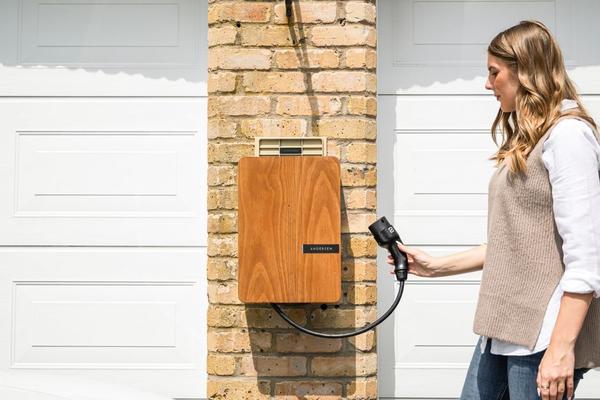
Andersen A3 — best for discreet cable storage.
This is a design-led tethered option aimed at households that want the charging cable kept tidier when the car is not plugged in. It suits buyers who care about how a charger looks on the front or side of a house as much as the basic charging experience. Check Andersen for current finishes, compatibility and installation requirements.
Before choosing a model, read how to choose home ev charger and check the manufacturer’s current information, because app support and tariff integrations can change.
Which home EV charger is easiest to install?
The easiest charger to install is the one your installer can fit as a standard job at your property. Cable route, consumer-unit condition, earthing arrangements, parking position and available electrical capacity usually matter more than the logo on the charger.
A compact 7kW-class charger may look simple on the wall, but the installation can become more involved if the cable run is difficult or the existing electrical system needs work. A proper ev charger site survey helps identify those issues before you commit to a unit or installation date.
The charger should also comply with current UK smart-chargepoint requirements where applicable, and the final installation must meet the relevant electrical safety and building rules. If you are relying on a government chargepoint grant, eligibility rules can also affect which model and installer you use.
A home EV chargepoint is fixed electrical equipment. Installation should be carried out by a competent installer who can assess the supply, protective devices, earthing and cable route and complete the work to the current UK electrical and building requirements; do not attempt work inside the consumer unit or fixed wiring yourself.
For a fuller view of what happens before, during and after fitting, see Home EV Charger Installation.
Is a 7kW home charger enough for most electric cars?
Yes, a 7kW home charger is enough for most UK electric-car households because cars are often parked at home for many hours. Charging speed is also limited by the car’s onboard AC charger, so fitting a more powerful wallbox does not guarantee faster charging.
The practical question is how much energy you need to replace between journeys. Overnight parking gives most households a long charging window, while several high-mileage EVs may justify checking whether a higher-capacity setup is possible.
Think of charger power as one part of a system. Your supply, the car and the wallbox all need to support the same level before you gain the benefit. For many homes, a well-installed 7kW unit with sensible scheduling is more useful than chasing the highest number on a product page.
Should I choose a tethered or untethered EV charger?
Choose tethered if you want the fastest everyday plug-in routine; choose untethered if you prefer a cleaner-looking wallbox and the freedom to use a separate cable. Neither is automatically better, so base the decision on where the car parks and how often you charge.
| What to compare | Tethered home charger | Untethered home charger |
|---|---|---|
| Daily routine | Cable is already attached, so you simply uncoil and plug in | You connect your own cable each time |
| Appearance when idle | Cable needs a holster or tidy storage method | Usually looks cleaner when no cable is connected |
| Cable flexibility | You use the charger’s built-in cable | You can choose a separate cable that suits your vehicle and parking layout |
| Changing vehicles | Best where the attached connector suits the cars you expect to own | Can be more flexible if future vehicles use a compatible socket and separate lead |
| Best fit | Frequent charging and convenience-first households | Drivers who value a tidy frontage or want to store the cable separately |
Most modern UK EVs use a type 2 connector for AC home charging, but you should still check the vehicle before buying. With a tethered cable, also make sure the parked car can be reached comfortably without stretching the lead across a route where people walk.
Untethered units can look neater when idle. Tethered units win on convenience because there is no separate cable to fetch before plugging in.
Which smart features are actually useful?
Smart charging is most useful when it removes decisions from the routine. Look for scheduling, remote start and stop, charging history, load management and sensible integration with the electricity tariff you actually use rather than a long feature list you may never open.
Solar-aware charging is useful if you have photovoltaic panels. Connectivity matters too: some chargers use home Wi-Fi, while others use mobile data, so check signal availability at the parking position.
When is a home EV charger not worth buying?
A dedicated charger may not be worth buying if you cannot park close enough to your property to use it legally and safely. A cable should not simply be run across a public pavement. If you rely entirely on street parking, first check local charging provision and whether an approved cross-pavement solution is available where you live.
It may also be poor value to pay extra for premium finishes, a screen or higher power that your home or car cannot use. If the electrical supply would need substantial upgrades, get the installation assessment first. The charger itself can be the easy part; extra electrical work can change which option makes sense.
Finally, do not replace a safe, compliant existing home charger just because a newer model has a better app. If your current unit charges reliably, supports the schedule you need and remains suitable for the car, the practical gain from changing hardware may be small. Spend only where the new charger fixes a real limitation.
Frequently asked questions
Do all electric cars in the UK use a Type 2 home charging connection?
Type 2 is the normal AC connection for most modern UK electric cars and plug-in hybrids, but you should confirm the inlet on your specific vehicle. An untethered charger also requires a separate compatible charging cable.
Can a home EV charger work with solar panels?
Yes, some smart home chargers can adjust charging around solar generation. The useful level of integration varies by charger, so check the current manufacturer guidance and make sure the installer understands the solar and household electrical setup.
Does a smart EV charger need Wi-Fi?
Not always. Some units use Wi-Fi, while others have mobile connectivity, and the connection method can affect app control and remote features. Check signal availability at the planned charger position before installation.
Can I have a home charger if I do not have a driveway?
Possibly, but the solution depends on your parking arrangement and local rules. UK support now includes some routes for eligible households with on-street parking and approved cross-pavement solutions, so check current government guidance before buying hardware.
Do I need a smart meter to use a smart home EV charger?
A smart charger can still have scheduling and app functions without every tariff feature being available. Some electricity tariffs or integrations may depend on compatible metering, so confirm the requirements with your energy supplier and charger manufacturer.
The best charger is the one that fits your car, parking layout, electricity supply and daily routine with the least friction. For most households, that means starting with a smart 7kW-class unit, choosing tethered or untethered deliberately, and letting the installation assessment rule out features your property cannot use.