
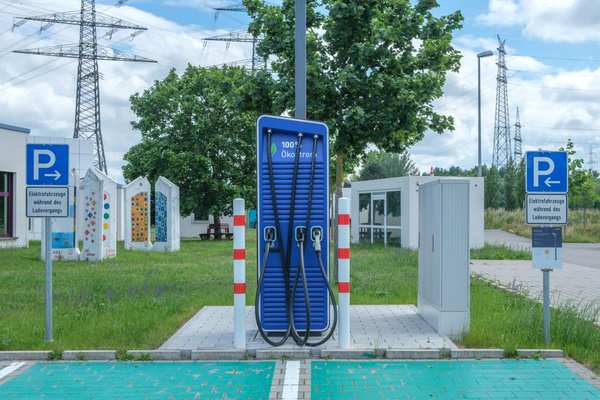
What should I know before choosing a charging station for evs?
A charging station for evs should match your car’s connector, the charging speed it can accept and where you plan to charge. At home, a dedicated wallbox is usually the practical choice; on the road, public units range from slower AC points to rapid DC chargers. Check the plug, power and displayed tariff before starting.
EV charging looks simple until you meet different plugs, power ratings and payment methods. Judge a charger by what your car can accept, what the station can supply and what you will actually pay for the electricity.
The £662 annual figure assumes a 7,400 W home wallbox runs at full rated power for one hour every day for 365 days. The working is 7,400 W ÷ 1,000 = 7.4 kW; 7.4 kW × 1 hour × 24.5p/kWh = 181.3p, or £1.81 for that hour at the July 2026 cap rate; £1.813 × 365 = £661.75, rounded to £662 a year.
What is a charging station for EVs?
An EV charging station is equipment that supplies electricity to an electric vehicle through a compatible cable and connector. It may be a home wallbox, workplace point or public charger, while the car limits how much of the available power it can accept.
For the wider category, start with ev charging stations. An ev smart charging station can schedule charging around a chosen time or tariff, while a portable ev charging station is a separate type of equipment that needs the right supply and connector.
What charging speeds are available at EV stations?
Charging speed depends on the station’s rated output and the maximum rate your vehicle can accept. A higher-rated charger does not force extra power into the car; the usable rate is limited by whichever side is lower.
For home charging, a 7,400 W wallbox is a useful reference. At 24.5p/kWh for the July 2026 cap period, one hour at the full 7.4 kW rate costs £1.81: 7.4 kW × 1 hour × 24.5p/kWh = 181.3p. Your real session depends on the kWh the car actually takes and your unit rate.
A three-pin charging arrangement is much slower. Using 2,300 W, the calculation is 2,300 W ÷ 1,000 = 2.3 kW; 2.3 kW × 1 hour × 24.5p/kWh = 56.35p, or 56.4p for that hour at the July 2026 cap rate. The lower hourly figure reflects lower power delivery, not a different electricity price.
Public chargers can offer higher AC or rapid DC power, but the figure printed on the unit is still a maximum. Battery temperature, charge level and the vehicle’s own limit can reduce the rate during a session. For faster public charging, see ev quick charging stations.
Which connectors are common at UK EV charging stations?
Type 2 is commonly used for AC charging in the UK, while CCS is widely used for rapid DC charging on newer vehicles. Some older electric cars may use CHAdeMO, so your own vehicle inlet matters more than the number of plugs shown on a charging map.
A home wallbox may be tethered, with its cable permanently attached, or untethered, where you use your own cable. Before buying or using equipment, confirm that the cable end and vehicle inlet match and that the cable is intended for that charging arrangement.
Do not assume an adaptor makes every station a safe match for every car. Follow the vehicle and charging-equipment manufacturer’s instructions, especially for adaptors, extension leads or non-standard accessories. If you are considering equipment rather than a fixed installation, portable ev charging station covers that separate use case.
How do home and public charging stations differ?
Home charging uses your household electricity tariff, while public charging adds an operator, a displayed tariff and usually a payment step. Public stations can offer much higher power, but their price and access conditions are set by the operator rather than your domestic tariff.
At home, calculate the cost directly from your unit rate. Using 7,400 W at 24.5p/kWh for the July 2026 cap period, 7.4 kW × 1 hour × 24.5p/kWh = £1.81 for one hour at full output. For a real session, multiply the kWh added to the battery by your p/kWh rate.
For a public station, do not reuse the domestic 24.5p/kWh figure unless the operator actually displays that rate. Read the price shown on the charger or in its app before connecting because the unit rate, connection fee, overstay charge or parking terms may differ.
A home unit can also include scheduling and load-management features. If you want charging to start at a chosen time or respond to household demand, see ev smart charging station. Smart control changes when or how power is delivered; it does not change the arithmetic used to calculate electricity consumed.
What should I check before using an unfamiliar charging station?
Check connector compatibility, maximum charging power, the displayed p/kWh tariff and any parking or session conditions. Then make sure the station appears physically intact and that the payment method shown on the unit matches the operator you intend to use.
- Connector: confirm the plug matches your vehicle inlet without relying on an unapproved adaptor.
- Power: know the maximum rate your car can accept.
- Price: read the current p/kWh rate and any separately stated fees before starting.
- Access: check whether the site needs an app, RFID card, contactless payment or account.
- Parking: read bay restrictions and overstay terms because charging and parking rules can be separate.
If the unit looks damaged, the cable is split, the connector is loose or the instructions do not match the equipment, do not improvise. Use another point or contact the operator. Home electrical installation should be handled by a suitably qualified installer rather than treated as a DIY charging project.
When does home EV charging not work as neatly as it looks?
A driveway, a tidy wallbox and a cable reaching the car make home charging look effortless in photographs. That picture does not fit every UK home. If you rent, the landlord may control whether equipment can be fixed to the property, and you should not install anything that breaches the tenancy. In a flat or a home without off-street parking, running a cable across a pavement or shared access is not a sensible workaround and may create safety or permission problems.
The electrical supply can also be the limiting factor. A desired 7,400 W charger does not mean the property can automatically support it at full output alongside the rest of the household load. A qualified installer needs to assess the installation and any required load management. Public charging is not automatically a clean substitute either: availability, connector type, operator access and the displayed p/kWh tariff can all vary. If those constraints apply, the best charging station for evs may be the one you can reliably and lawfully use, not the fastest unit on a specification sheet.
Frequently asked questions
Does a higher-power charger always charge my EV faster?
No. The car can only accept power up to its own charging limit, and that limit can vary during the session. A station rated above the vehicle’s maximum may therefore provide no extra speed for that car.
How do I calculate the electricity cost of home EV charging?
Multiply the energy used in kWh by your unit rate in p/kWh, or convert charger power from watts to kW and multiply by hours and the unit rate. At 7,400 W for one hour and 24.5p/kWh under the July 2026 cap rate, 7.4 × 1 × 24.5p = 181.3p, or £1.81.
Can I use a three-pin socket instead of a wallbox?
A 2,300 W three-pin charging arrangement is much slower than the 7,400 W wallbox example. At 24.5p/kWh for the July 2026 cap period, one hour at 2.3 kW works out at 56.4p; use only equipment and connections permitted by the relevant manufacturers.
Do I need an app to use every public charger?
No. Access methods differ by operator and site, so some chargers may support contactless payment while others use an app, account or RFID card. Check the instructions and displayed tariff on the station before starting.
What should I do if the charger cable or plug looks damaged?
Do not use damaged charging equipment or try to repair it at the roadside. Choose another station and report the fault to the operator using the contact details shown on the unit or its official service.
A charging station for evs is easiest to choose when you treat connector, power and price as separate checks. Match the plug to the car, understand the rate the vehicle can accept, and calculate home charging from the real kWh used and the dated unit rate rather than relying on a headline speed.