
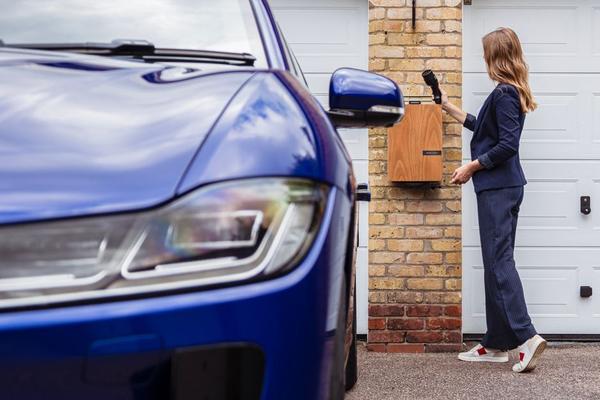
How long should a long ev charging cable be at home?
A long ev charging cable should reach your car’s charging port with enough slack for normal parking changes, without leaving metres of cable lying across the drive. For many homes, 10 metres is generous; 15 or 20 metres is more useful where the charger and parking position are genuinely far apart.
Cable length is mostly a question of driveway geometry, where the wallbox sits and which side of the car carries the charge port. Measure the real route the cable will take, not a straight line through the car, a wall or a gate.
The annual figure assumes four hours of 7.4 kW charging each week, or 208 hours a year. The working is 7,400 W divided by 1,000 = 7.4 kW; 7.4 × 1 hour × 24.5p/kWh = 181.3p for one hour, and 7.4 × 208 hours × 24.5p/kWh = 37,710.4p, or £377.10 a year at 24.5p/kWh in the July 2026 cap period.
What counts as a long EV charging cable for home use?
For a typical home setup, a cable around 10 metres is already long enough to cover many awkward parking positions. A 15 or 20 metre cable starts to make sense when the wallbox is well away from the car, the vehicle may be parked nose-in or nose-out, or the charging port moves between different cars.
If you are still deciding on the basic cable type, connector and rating, the main ev charging cable guide is the better place to settle those choices first. Length comes after compatibility and current rating, not before them.
A 10m ev charging cable is often the practical upper end for a straightforward private driveway. A 15m ev charging cable suits longer or offset parking spaces, while a 20m ev charging cable is more specialised because the extra reach also brings extra weight, bulk and storage work.
| Driveway consideration | 10 metre cable | 20 metre cable |
|---|---|---|
| Typical reach | Usually enough for a wallbox beside or near the parking bay | Useful where the charger is much farther from the usual charge-port position |
| Parking flexibility | Allows moderate changes in nose-in or nose-out parking | Gives more freedom where several parking positions must be covered |
| Handling | Easier to lift, carry and coil after charging | Heavier and slower to put away neatly |
| Trip exposure | Less spare cable is likely to lie on the ground | More careful routing is needed to keep unused length out of walking routes |
| Storage space | Needs a modest hook, holder or box | Needs a larger, well-positioned storage point that can take the full coil |
How much extra cable should I allow for parking changes?
Allow enough extra length for the car to sit slightly farther forward or back than usual and still reach without tension. In most cases, a modest margin is more useful than buying the maximum length available simply because it exists.
Measure with the car parked in the positions you actually use. Follow the route from wallbox to charge port around the edge of the vehicle, adding the turns the cable must make at posts, gates or walls. Then repeat the measurement with the car reversed if that is a realistic parking pattern.
Think about the next car too. Charge ports can sit at the front, side or rear, so a replacement vehicle may shift the connection point by several metres. If your measured route is already close to 10 metres, 15 metres can provide useful margin; if the route is six or seven metres, 20 metres is usually needless bulk.
Does a longer EV cable reduce charging efficiency?
A longer cable has more conductor length, so its electrical resistance is higher than that of an otherwise identical shorter cable. In a correctly specified EV lead used within its rated current, that does not normally mean a dramatic change in the energy delivered to the car, but it is still a reason to buy proper equipment rather than improvise with extensions.
Cable design matters as much as distance. Conductor size, connector quality and rated current affect how safely the lead carries power, so buy a lead designed for the charging current rather than improvising with a domestic extension.
Keep the electricity calculation tied to the charger’s power. At 7.4 kW and 24.5p/kWh in the July 2026 cap period, one hour is 7.4 × 24.5p = 181.3p. Cable length is not a reason to choose a lead that cannot comfortably reach the car.
If you need reach beyond a normal tethered or detachable lead, read about an ev charging cable extension before assuming an ordinary extension is suitable. EV charging is a sustained high-power load, and equipment must be designed and rated for that job.
How do I store a long EV cable without damaging it?
Store it in broad, loose coils with the connectors supported and kept clear of standing water, grit and vehicle tyres. The longer the lead, the more important it is to give the full cable a dedicated place rather than dropping the spare length beside the wallbox.
A fixed ev charging cable holder can keep a 10 or 15 metre lead off the ground, while an ev charging cable storage box can be useful where the connection point is exposed to dirt or the cable would otherwise sit in a walking route.
- Use wide coils: avoid tight loops that force repeated sharp bends into the same section of cable.
- Support the plug: do not leave the connector hanging by the cable or resting where a car can run over it.
- Keep the route tidy: uncoil only the length you need, then place unused cable where people do not step over it.
- Check before plugging in: look for cuts, crushed sections, damaged pins or a connector that no longer seats normally.
When is a very long charging cable the wrong solution?
A very long lead does not solve every awkward parking arrangement. In a rented home, you may not control where a wallbox can be fitted, and landlord permission can matter more than another five or ten metres of cable. In a flat or a property with shared parking, a cable that must cross a communal route can create a problem that extra reach does not remove.
It is also the wrong answer when the only workable route runs across a public pavement, through a gate that can crush the lead, or through the normal walking line to the front door. A photograph of a neatly looped 20 metre cable can look flexible; daily life is different when that same coil is wet, heavy and underfoot. If the charger is consistently in the wrong place, ask a competent EV charge-point installer whether relocation or a different mounting position is practical. Do not use a domestic extension lead as a casual workaround, and do not route a charging cable in a way that breaches a tenancy condition, damages the lead or creates an obvious trip hazard.
Frequently asked questions
Is 10 metres enough for most home EV charging?
Ten metres covers many private-driveway layouts where the wallbox is mounted close to the parking space. Measure the actual route to your car’s charge port first, including bends around the vehicle, because a straight-line measurement can understate the length you need.
Should I buy 15 metres instead of 10 metres just in case?
Buy the extra five metres when your measured route is already close to the limit or when you genuinely use more than one parking position. If you have several metres of spare reach at 10 metres, the longer lead mainly adds weight and storage bulk.
Can I drive over an EV charging cable?
Do not make driving over the cable part of the normal setup. Repeated crushing can damage the outer sheath or internal conductors, so route the lead where tyres do not cross it and inspect any cable that has been trapped or run over.
Is an extra-long cable better than moving the wallbox?
Not always. If a long lead still crosses doors, paths or shared access on every charge, a better wallbox position may produce a safer and simpler daily setup; any electrical alteration should be assessed and carried out by a competent installer.
Choose the shortest cable that comfortably covers your real parking positions, with a sensible margin for a different charge-port location. Ten metres is ample for many homes; 15 or 20 metres earns its place only when the measured route needs it and you have a safe way to handle and store the extra length.
Park the car as you actually use it, measure the route, and make sure the cable reaches without tension, wheel contact or a permanent trip line.