
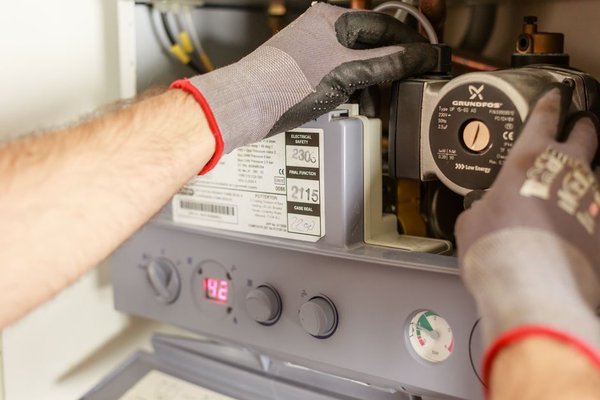
What does a central heating circulator pump do?
A central heating circulator pump moves hot water from the boiler through radiators or underfloor heating and back again. It does not generate heat or set room temperatures. If circulation weakens, radiators may warm unevenly, pipes may become noisy and a working boiler may shut down because its heat cannot move through the circuit properly.
If the boiler fires but rooms remain cold, water movement is one possible explanation. Air, valve settings, blocked filters and heating controls can produce similar symptoms, so the pump should be investigated rather than blamed automatically.
Definition: A circulator is an electrically driven pump that moves the same heating water around a closed circuit. Its spinning impeller creates the pressure difference needed to overcome resistance from pipes, valves and radiators. It circulates water; it does not add fresh water to the heating system.
What does a central heating circulator pump control?
It controls water circulation within the limits of its design and setting. It does not independently decide whether a room needs heat, ignite the boiler or choose the temperature delivered to each radiator.
The central heating pump allows energy made by the boiler to reach the rooms. When flow is inadequate, the boiler may reach its temperature limit while the heating circuit still has cool areas. A pump must provide enough movement against the resistance of the whole system, not merely make a humming noise.
Water flow and room temperature are separate
Room thermostats and programmers request heating. Radiator valves influence which emitters receive water, while the pump circulates it through the available paths. In some homes it is built into the boiler; in others, the central heating circulating pump is mounted separately on the pipework.
How does a circulator pump respond to heating demand?
When controls call for heat, the system arranges boiler and pump operation so heated water can reach the radiators. Some installations continue circulating briefly after the burner stops to carry residual heat away, so a pump running after the thermostat switches off is not automatically faulty.
Electronic pumps and changing resistance
Modern circulators may alter speed or maintain a programmed pressure as radiator valves close. Manufacturers offer modes such as proportional pressure, constant pressure and fixed speed. The correct mode depends on the pipework and heat emitters, not on which button looks simplest.
For a concrete electrical example, Wilo specifies a 4–20 W input range for a Yonos PICO 15/1-4 variant. The figure in the block above assumes a steady 20 W for eight hours a day on 180 days each year; it is an illustration, not a claim about every home or pump.
The calculation is 20 W ÷ 1,000 = 0.020 kW. For one hour, 0.020 × 1 × 26.32p/kWh = 0.5264p, shown as 0.53p. For the stated year, 0.020 × (8 × 180) hours × 26.32p/kWh = 758.016p, or £7.58. That unit rate is Ofgem’s October–December 2026 average for default-tariff direct-debit electricity in England, Scotland and Wales; regional rates and individual tariffs vary. Northern Ireland uses different arrangements.
What symptoms point to weak circulation rather than a boiler fault?
Circulation is worth checking when the boiler starts but multiple radiators warm slowly or unevenly. These signs are not proof: trapped air, poor balancing, shut valves and blocked components can create almost identical behaviour.
Record what happens without removing covers or opening pressurised fittings:
- Several radiators stay cool: identify whether the problem affects the whole system or one branch.
- Some pipework gets hot but distant radiators do not: note when and where the temperature changes.
- Rushing or gurgling sounds: these can indicate air, excess flow or a restriction rather than a failed motor.
- A boiler displays flow-related errors: record the exact fault code for the heating engineer.
- There is no apparent pump response during a heat demand: a control, electrical or mechanical fault needs professional diagnosis.
Useful evidence for the engineer
Note the boiler model, which radiators warm, whether domestic hot water works and when the fault first appeared. A photograph of an accessible pump label can help; do not dismantle the boiler to find it. Read about other central heating pump problems before concluding that the pump itself must be changed.
Never undo a pump vent, pipe union or electrical cover on a hot or pressurised system. A professional can distinguish failed circulation from sludge, an obstructed filter or air that requires appropriate bleeding.
Can a circulator pump be set too fast for a small system?
Yes. Excess pressure and flow may produce rushing water or valve noise, particularly as thermostatic radiator valves close. But setting the speed too low can starve distant radiators of the flow they need.
The number of radiators is not enough to choose a setting. Pipe diameter, length, fittings and heat demand affect the resistance the pump must overcome.
Why the fastest mode is not a cure
Increasing pump speed will not remove sludge or reopen a closed valve.
The guide to central heating pump speed explains the available settings. If radiators remain cool, ask for the system’s flow and restrictions to be checked rather than experimenting repeatedly with the controls.
What information matters when comparing a replacement circulator pump?
The replacement must suit the required flow and pressure, physical connections, electrical supply and control arrangement. Matching the appearance or wattage alone does not establish compatibility.
A product labelled central heating circulation pump may be intended for a different circuit or connection size. The same applies to catalogues advertising circulation pumps for central heating. Compare the manufacturer’s specifications with the actual installed equipment.
| Pump detail | Existing installation | Replacement to confirm |
|---|---|---|
| Connections | Record the fitted type and size. | Check compatible pipe connections. |
| Installation length | Identify the port spacing in mm. | Confirm the stated length in mm. |
| Flow and head | Establish circuit demand and resistance. | Match an appropriate pump curve. |
| Electrical supply | Identify supply and control requirements. | Confirm electrical compatibility. |
| Operating modes | Note the system and current mode. | Choose a suitable supported mode. |
The specified motor input is not a measure of the flow the unit can deliver. Before replacing central heating pump, an engineer should also assess system cleanliness, valve operation and whether the existing unit is genuinely defective.
For a circulator integrated into the boiler, follow the boiler maker’s approved replacement procedure. Gas appliance work must be performed by an appropriately Gas Safe registered engineer; electrical and pressurised-water work also require suitable competence. Do not make alterations that breach a tenancy or appliance warranty.
When will changing the pump fail to fix a cold home?
A new pump will not remove sludge from radiators, reopen a shut valve, repair a faulty thermostat or correct unsuitable pipework. If one radiator is cold while the others heat normally, a local restriction may be more likely than a failed circulator. Even several cold radiators do not prove a motor fault: trapped air and clogged strainers can imitate poor circulation. Replacing a healthy pump simply leaves the original problem in place.
Tenants should not order an independent replacement without the landlord’s permission. In many rented properties, heating repairs are the landlord’s responsibility; unauthorised work can create safety, warranty and tenancy disputes. Flats with communal heating may not even have an individual circulator for residents to change. A photograph of a pump in an online listing does not prove it fits your system.
A lower stated wattage also does not guarantee a particular bill reduction. Real electrical use depends on demand, settings and hours of operation. Ask for a diagnosis and a written explanation of why a new unit is needed before agreeing to the work.
Frequently asked questions
Is the heating circulator always inside the boiler?
No. Many modern boilers contain an integrated pump, while other systems have a separate unit on the heating pipes. The installation manual and pipe layout determine which arrangement you have.
Does a silent pump mean it has stopped?
Not necessarily. Efficient electronic pumps can operate quietly, and noise alone does not confirm that water is circulating correctly. Look at the wider heating symptoms instead of relying on sound.
Does the pump run when the boiler heats tap water?
That depends on the appliance and system design. Some boilers use an internal pump for hot-water operation, while cylinder systems may use separate controls. Consult the installed boiler’s manual.
Can poor circulation trigger a boiler shutdown?
Yes, some boilers stop or display a fault when heat cannot be removed at the required rate. Do not repeatedly reset an appliance that continues to fault; ask a qualified professional to investigate.
Can a homeowner safely replace a circulator?
The job can involve electricity, pressure, very hot water and boiler components, so it is generally unsuitable for an untrained person. Use a competent heating professional and a Gas Safe registered engineer where gas-appliance work is involved.
The circulator moves heat around the home, but a cold radiator does not by itself establish pump failure. Record the pattern, avoid dismantling the system and have the cause confirmed before buying a replacement.