
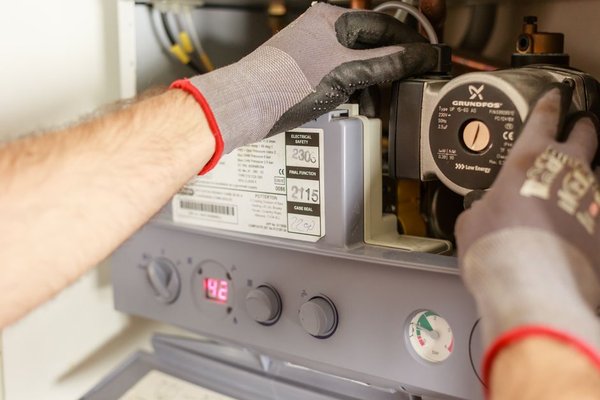
How should you plan a central heating pump change?
A central heating pump change starts by confirming the pump, rather than a valve, control or airlock, has failed. Before ordering, check the replacement’s dimensions, connections, electrical requirements and capacity. Arrange for a competent professional to isolate, fit and recommission it, then verify circulation, leaks and settings before accepting the job.
A new pump is not automatically the cure for cold radiators. Planning matters because inaccessible fittings, seized valves and an incompatible replacement can leave the heating off longer than expected.
What should be checked before a central heating pump change?
Confirm that the pump is actually responsible for the fault and establish whether it sits in the heating pipework or inside the boiler. Record the existing model, system symptoms and recent work before buying parts. A silent pump or cold radiator alone does not prove motor failure.
The central heating pump moves heated water around the circuit; it does not create heat. A blocked filter, faulty control, trapped air or closed valve can produce similar symptoms. Use these observations when describing the fault:
- Cold rooms: say whether all radiators or only certain ones are affected.
- Noise: note whether it starts with heating demand or persists throughout.
- Pressure: report changes shown on the boiler gauge, where fitted.
- Leaks: photograph visible damp joints without touching hot equipment.
See central heating pump problems for more diagnostic context. Ask the engineer to explain what distinguishes a failed pump from a circulation restriction before authorising its replacement.
Check the electricity calculation
The 40 W shown above is an illustrative operating draw, not a specification for every pump. Using Ofgem’s average electricity unit rate of 26.32p/kWh for direct-debit customers in Great Britain during October–December 2026, the calculation is 40 W ÷ 1,000 × 1 hour × 26.32p/kWh = 1.0528p, rounded to 1.05p an hour.
At eight hours of operation daily for 365 days, 40 ÷ 1,000 × 8 × 365 × 26.32p = 3,074.176p, or £30.74 a year. This illustration holds the October 2026 cap rate constant for the whole assumed year; future rates will change. Substitute your pump’s actual watts, hours and tariff rate for a household-specific figure.
How do you confirm a replacement pump will fit the existing connections?
Use the full model code and manufacturer specifications, not the appearance of the pump casing. The replacement must match the available installation length, union connections, flow direction and system requirements. The installer also needs to establish how the boiler controls it.
Circulators can have 130 mm or 180 mm port-to-port lengths, so a similar-looking replacement may not fit. The pipe unions and seals must suit the model, with enough room for the motor head and electrical connection. Photograph the existing assembly before requesting a quotation.
- Model plate: capture the complete identifier and existing speed information.
- Connections: confirm centre-to-centre dimensions, union threads and sealing arrangement.
- Hydraulic duty: check required flow and head against the circuit.
- Controls: verify whether the boiler specifies an integrated or controlled pump.
- Orientation: check the marked water-flow arrow and manufacturer’s installation restrictions.
For the meaning of flow and head, consult central heating pump sizing calculator. Any sizing exercise supports, rather than replaces, the manufacturer’s approved component selection.
Do pump isolation valves need checking before the job starts?
Yes. Valves beside an external pump can sometimes isolate it without draining the complete heating circuit, but old valves may seize or fail to seal. Ask the installer to assess them before booking a straightforward swap.
Identify leaks, corroded unions, awkward access and whether the system can be cooled and safely isolated. Never force an old valve yourself; hot pressurised water can escape if it breaks. Have the engineer confirm whether draining, refilling or additional fittings will be needed.
Put central heating pump valves on the quotation checklist, alongside seals and any associated filter. For a pump built into a gas boiler, the boiler manufacturer’s procedure applies instead; work on gas appliances or safety-critical parts needs a Gas Safe registered engineer. Electrical connections require a competent person.
What are the steps for planning the replacement?
Use this sequence to agree the work and check the handover. It is not a guide to disconnecting mains wiring or opening pressurised heating pipework yourself.
- Diagnose the fault: ask which observations or tests show that the pump, rather than a valve, filter or control, needs replacing.
- Identify the unit: photograph its full model label, connections and location; check the boiler documentation for restrictions.
- Choose a compatible part: have the professional confirm dimensions, hydraulic performance, control method and electrical connection before ordering.
- Agree the quotation: request dated figures in £ for parts, labour, valves, seals and VAT, with possible extra work identified separately.
- Prepare safe access: clear the area and let the installer plan cooling, electrical isolation and any necessary draining.
- Fit and recommission: the professional makes the connections, restores the circuit, deals with air and selects manufacturer-appropriate settings.
- Check the handover: request the model details, final settings, warranty information and results of leak and circulation checks.
What settings need checking after the new pump is installed?
The pump’s operating mode and speed or pressure setting must suit the heating system, not merely the factory default. The installer should then check that the boiler calls for heat, water circulates and the radiators respond. A powered display does not prove the hydraulic side is working.
Modern circulators may offer different pressure-control modes, while some pumps are directed by the boiler. The article on central heating pump speed explains the significance of the selected mode. Ask the installer to show the setting and record it before leaving.
- Confirm the pump responds to heating demand without a new boiler fault code.
- Check accessible joints for drips after the circuit warms.
- Confirm radiator performance and any needed system balancing.
- Ask whether air, system pressure and filters have been checked.
What problems can show up after a pump change?
A newly fitted pump can still be followed by leaks, gurgling, vibration or poorly heated rooms. Some faults involve air or existing pipework rather than the replacement itself. Record the symptom and contact the installer instead of repeatedly adjusting controls.
- Joint leaks: a seal, union or old valve may need professional attention.
- Gurgling: trapped air may remain after refilling and commissioning.
- Whistling: inappropriate settings or flow restriction may need investigation; see noisy central heating pump.
- Cold radiators: balancing, blockage or a separate control fault may remain unresolved.
- Repeated boiler lockouts: record the code and arrange a qualified assessment rather than resetting repeatedly.
Check how the system behaves during the next complete heating cycle and photograph any new leak. Report changes promptly, especially where there is water near electrical components.
When will replacing the pump not fix the heating?
Changing a pump will not clear a blocked heat exchanger, repair faulty boiler controls or correct badly balanced radiators. If nobody established that the old pump had failed, the replacement may simply leave you with the original problem. A photograph of tidy new pipework looks reassuring but says nothing about whether heat reaches every room.
In a rented property, report the problem to the landlord or managing agent rather than commissioning unauthorised changes. In a flat with communal heating, the pump may serve several homes; a resident should not specify replacement without the system operator’s approval. Boiler warranties may also restrict who can work on internal components.
Nor is replacement automatically justified by an electricity claim. The illustrated £30.74 a year at 26.32p/kWh (October 2026 cap) assumes 40 W and eight hours of operation each day, not a saving. Without the old pump’s measured consumption, the new pump’s actual duty and the dated installed quotation, there is no defensible recovery period. Confirm the fault and responsibilities before paying for work that may not help.
Frequently asked questions
Can I replace the circulation pump myself?
This can involve hot pressurised water and mains electricity, so use a competent professional. Work involving a gas appliance or its safety-critical components must be undertaken by a Gas Safe registered engineer.
Does a new pump use the same setting as the old one?
Not necessarily, because control modes vary between models. The installer should select and record the appropriate setting for the circuit.
Must both isolation valves be replaced?
No, but they need checking for leaks, seizure and reliable closure. The installer should explain any necessary additional work before starting.
Will a pump vent all the air from my radiators?
Some units have a venting function, but commissioning still needs to cover the heating circuit. Ask the installer to confirm the air and pressure checks performed.
Can I choose a different pump brand?
Only if the alternative meets the boiler maker’s requirements and the system’s hydraulic, electrical and dimensional needs. Have compatibility confirmed before buying it.
A successful change is one that fixes a verified fault and restores reliable circulation. Check the specification and valves before ordering, and ask for documented commissioning after installation.