
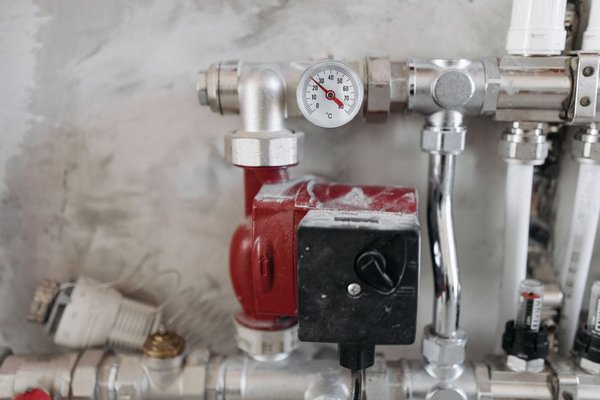
How do you use a central heating pump sizing calculator?
A central heating pump sizing calculator needs two results: the water flow required to carry the system’s heat output and the pump head needed to overcome resistance in the circuit. Calculate flow from heat load and temperature difference, then calculate head from pipework and component pressure losses before checking the pump curve.
A central heating pump sizing calculator is most useful as a duty-point check, not a way to choose the biggest circulator available. The target is enough flow at enough head for the most demanding circuit, with suitable control when heating demand falls.
The 40 W figure is a worked example using the published maximum input of a Wilo Yonos PICO1.0 25/1-6. The working is 40 W ÷ 1000 = 0.04 kW; 0.04 kW × 1 hour × 26.11p/kWh = 1.0444p, rounded to 1.0p an hour. For the annual figure, the assumption is 8 hours a day at 40 W: 0.04 kW × 8 × 365 × £0.2611/kWh = £30.50 a year at the Ofgem average rate for 1 July to 30 September 2026. A modulating pump can draw less than its maximum for much of the heating season.
What information do you need to size a central heating pump?
You need the design heating load in kW, the intended flow and return temperatures, and enough detail about the pipe circuit to estimate pressure loss. You also need the manufacturer’s performance curve to confirm that a pump can deliver the required flow at the calculated head.
Do not automatically use a combi boiler’s headline output. Part of that rating may relate to domestic hot water, and an older boiler may be larger than the home’s actual design heat loss.
For practical central heating pump sizing, collect:
- the design heat load in kW for the pumped circuit;
- the design flow and return temperatures;
- pipe material, internal diameter and developed length of the critical route;
- the fittings, valves, filters and heat exchangers on that route; and
- manufacturer pressure-loss data and the proposed pump curve.
If you are starting from a general guide to the central heating pump, keep flow and head as separate figures until you check the duty point.
A clear calculation sequence
- Establish the design heat load: use the heating demand of the circuit the pump serves.
- Confirm the temperature difference: subtract return temperature from flow temperature to get delta T.
- Calculate required water flow: convert heat load and delta T into m³/h.
- Identify the index circuit: trace the hydraulically most demanding route from the pump and back.
- Add the pressure losses: include straight pipe, fittings, valves, filters and heat exchangers at design flow.
- Convert the total to pump head: use metres of head if that is how the pump curve is shown.
- Check the duty point: confirm the pump curve can deliver the required m³/h at the required head.
- Set the control mode: commission the pump for the system rather than assuming maximum central heating pump speed is correct.
How do you estimate required heating water flow?
Required heating water flow depends on heat output and the temperature drop between flow and return. For water, a useful design relationship is flow in m³/h = heat load in kW ÷ (1.163 × delta T in °C).
If a circuit must deliver 18 kW with a 20°C design temperature difference, the required flow is 18 ÷ (1.163 × 20) = 0.77 m³/h. Use that figure at the pump-curve check rather than treating it as a fixed speed setting.
The temperature difference matters because a smaller delta T needs more water flow to move the same heat. Use the temperatures intended for the actual system rather than copying a figure from another boiler, heat pump or radiator design.
An existing domestic central heating pump should therefore be judged by its performance curve, not by body size or connection size alone.
What does pump head represent in a domestic system?
Pump head is the pressure energy the circulator must provide to overcome resistance while water moves around the closed heating circuit. In a normal sealed closed-loop system, it is not simply the vertical height from the boiler to the highest radiator.
The rising water column is balanced by the returning water column. The circulator mainly works against dynamic resistance from pipe friction and components such as radiator valves, zone valves, filters, heat exchangers and manifolds.
That means a taller house does not automatically need extra head just because the top radiator is higher. The correct head comes from the resistance of the index circuit at the required design flow, and the useful selection point is where that system requirement meets the pump curve.
If the duty point is outside the curve, changing central heating pump speed may not fix the underlying hydraulic problem.
How do pipe length and fittings affect pump sizing?
Longer pipe runs and restrictive components increase pressure loss, so they increase the head the pump must produce at a given flow. Smaller internal pipe diameter, tight bends and partly closed valves can increase resistance further.
Use the developed length of the critical route, meaning the actual supply-and-return path water follows. Then add the losses from elbows, tees, thermostatic radiator valves, lockshields, motorised valves, filters, the boiler heat exchanger and other components on that route.
There is no reliable universal shortcut based on pipe length alone. A compact circuit can still have high resistance, while a longer circuit with larger pipe and low-resistance components may be easier to pump.
If circulation is already poor, check central heating pump problems and system condition rather than assuming the pump is undersized.
When should pump sizing be checked by a heating professional?
Professional checking is sensible when the system layout is complex, the design heat load is uncertain, or the calculated duty point is close to the edge of a pump curve. It is also appropriate where the circulator is inside a boiler or changing it could affect warranty conditions.
Get a competent heating professional involved for several zones, underfloor heating manifolds, hydraulic separators, extensive microbore pipework, mixed radiator and underfloor circuits, or repeated noise and balancing problems. These arrangements can have interactions that a simple calculator does not capture.
If access requires opening the combustion case of a gas boiler or working on gas components, that is Gas Safe registered work. Do not remove sealed boiler covers or bypass manufacturer instructions to reach a circulator.
For replacement work, the proposed central heating circulating pump should match both the hydraulic duty and the physical connection and installation length.
When does a calculator-style pump sizing method not work on its own?
A simple calculator stops being reliable when the inputs are guesses. If the heat load is copied from the boiler badge, the pipe diameters are unknown, valves have changed over the years, or the index circuit cannot be identified, the answer can look precise while being hydraulically wrong. The same applies to mixed systems with radiators, underfloor heating, multiple pumps, hydraulic separators or proprietary boiler controls: one flow figure and one head figure may not describe how the circuits interact.
It also does not override ownership or safety limits. In a rented home, the landlord or managing agent may control alterations, so a tenant should not swap a pump without permission. If the pump is inside a gas boiler, access may require a Gas Safe registered engineer. A tidy diagram can make sizing look like a two-number exercise; an older installation may contain sludge, balancing faults, hidden restrictions or undocumented alterations. Where those uncertainties matter, inspect and measure the real system rather than pretending the calculator has supplied certainty.
Frequently asked questions
Can I size a pump from the boiler kW rating alone?
Not reliably. Use the design heat load for the pumped heating circuit and its intended flow-to-return temperature difference; a boiler’s maximum rating may include domestic hot water output or exceed the building’s actual space-heating requirement.
Is a 6 m head pump automatically better than a 4 m head pump?
No. The useful pump is the one whose performance curve covers the required flow at the calculated system head, with suitable control at part load. Excess available head can contribute to valve noise if the system is not commissioned correctly.
Does a taller house always need more circulator head?
No, not in a normal closed heating loop. Static height is largely balanced by the returning water column, so selection is driven by friction and component resistance at the required flow rather than building height alone.
Can I use the highest pump setting to fix cold radiators?
Not as a first diagnosis. Cold radiators can result from air, sludge, closed valves, poor balancing or control faults, so maximum pump output can create noise without solving the cause.
The central heating pump sizing calculator method is straightforward when the inputs are sound: calculate required water flow, calculate the resistance that flow will meet, and check both against the pump curve. If the system is undocumented, noisy, badly balanced or hydraulically complex, use the calculation as a starting point and have the installation checked before changing equipment.