
Which circulation pumps for central heating should I compare?
Compare circulation pumps for central heating by whether they run at a fixed speed or adjust their output as radiator valves open and close. A variable-speed electronic circulator can respond to changing demand, but the correct replacement must also match the existing pipe connections, hydraulic requirements and boiler controls.
A pump that fits the pipework is not automatically the right one for the system. Compare how each control type behaves, the electricity it draws and whether it circulates enough water without creating noise.
What types of circulation pumps are used for central heating?
Domestic wet central heating generally uses an electrically driven circulator to move heated water around radiators or other circuits. The main distinction when comparing replacements is between fixed-speed designs and electronically controlled variable-speed models.
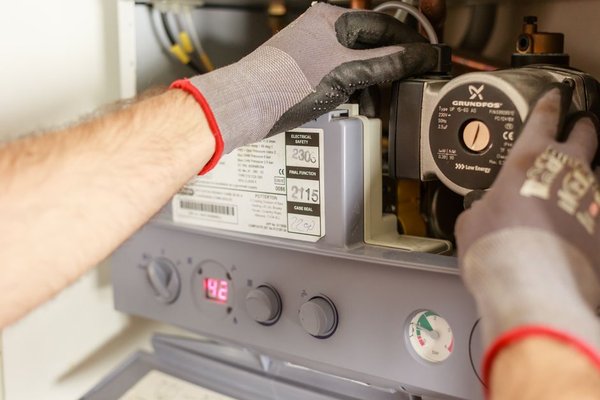
Some boilers contain an internal pump; other systems use a separate unit in the heating pipework. Both move water around a closed circuit rather than pumping water from the mains. Check the boiler manual before assuming that a separate model can replace an integrated component.
A domestic central heating pump also has a hydraulic rating describing the flow it can deliver against resistance from pipes, radiators and valves. High maximum speed is not proof of suitability: inadequate flow may leave radiators underheated, while excessive pressure can make valves hiss. The central heating pump guide covers the basic components and their purpose.
What is the difference between fixed-speed and variable-speed pumps?
A fixed-speed pump runs at its selected motor setting whenever the heating controls energise it. A variable-speed model can adjust its speed according to its pressure-control programme as valves open or close.
The following table contrasts operating behaviour, not a promise that every product of one type draws the same wattage.
| Pump behaviour | Fixed-speed circulator | Variable-speed circulator |
|---|---|---|
| Motor operation | Maintains the chosen speed while running | Adjusts speed within a selected programme |
| Radiator valves closing | May maintain excess differential pressure | Can reduce output as demand falls |
| Available settings | Usually manual speed positions | Pressure-control modes, sometimes fixed-speed curves |
| Electrical input | Stays nearer its selected operating point | Can fall when the motor slows |
| Commissioning | Speed must suit the circuit’s resistance | Pressure mode and setpoint still need selection |
Do not choose from a photograph of the casing. Some Wilo Yonos PICO variants include proportional-pressure, constant-pressure and fixed-speed settings in one electronically controlled unit. Its chosen mode determines its behaviour. If radiator noise is the concern, read about central heating pump speed before selecting a higher setting.
Do modern circulation pumps use less electricity at lower demand?
They can, provided the selected control responds to reduced demand and suits the heating circuit. The motor uses less electrical power as it slows; the word electronic alone is not proof of a particular consumption figure.
For a concrete specification, Wilo lists an electrical input range of 4–20 W for its Yonos PICO 15/1-4 model. The 20 W in the block above assumes operation at that level, not a prediction of the pump’s real average in every home.
Using Ofgem’s average direct-debit electricity rate of 26.11p/kWh for Great Britain during the July–September 2026 cap, one hour works out as 20 ÷ 1,000 × 1 × 26.11p = 0.5222p, rounded to 0.52p. At eight hours a day for 180 days, 20 ÷ 1,000 × 8 × 180 × 26.11p = 751.968p, or £7.52 a year at 26.11p/kWh (July 2026 cap).
For comparison, imagine an existing pump drawing a constant 60 W during the same eight hours a day for 180 days. Its calculation is 60 ÷ 1,000 × 8 × 180 × 26.11p = 2,255.904p, or £22.56 a year at 26.11p/kWh (July 2026 cap). Against a constant 20 W draw, the difference is £15.04 a year at 26.11p/kWh (July 2026 cap), excluding purchase and fitting costs. The 60 W is an illustrative assumption, not a measurement of a particular old pump.
Your actual total depends on operating hours and changing input power. Read the display or ask a professional for an appropriate measurement. The calculation excludes boiler gas use and electricity standing charges; regional rates and payment methods also vary.
Which pump controls matter in a domestic heating system?
Pressure behaviour, speed limits and interaction with the boiler matter more than a long menu of display functions. The suitable programme depends on radiator valves, zone valves, underfloor circuits and any required minimum flow.
Proportional pressure and constant pressure
Proportional-pressure control reduces its pressure target as flow demand falls, often relevant when thermostatic radiator valves close. Constant-pressure control aims to hold a selected differential pressure as flows change, which may suit particular manifolds or circuits. Follow the system designer’s guidance rather than choosing a mode from a general online recommendation.
A constant-speed curve may also be available on an electronic unit. Wattage displays can help check electrical input, but do not measure heat delivered to radiators. Venting functions and fault indicators assist servicing without replacing diagnosis.
- Boiler operation: Confirm the pump’s supply and any required run-on period after firing.
- Minimum flow: Follow boiler instructions on flow and bypass arrangements.
- Noise: Hissing valves may indicate excessive differential pressure, but air or restrictions can also cause noise.
- Speed: Avoid choosing the highest setting without considering the pump curve.
A central heating circulator pump serving several zones encounters changing resistance during the day. Checking central heating pump valves is therefore relevant when an installer chooses the pressure setting.
How do you compare replacement pumps for an existing system?
Start with the old pump’s model number, not a retailer’s general claim of universal compatibility. Check connection dimensions, pump head, required flow, electrical supply and boiler controls against the manufacturer’s documentation.
Product listings give port-to-port length in millimetres and often pump head in metres. Pump head measures pressure capability, not the height of a house. A competent installer should match the system’s required flow and resistance to the replacement’s performance curve.
- Existing identification: Record the model and visible label details without opening electrical covers.
- Physical fit: Confirm union fittings, pipe size, body length and mounting position.
- Hydraulic match: Check required flow and head rather than just the advertised maximum speed.
- Controls: Verify wiring, boiler instructions, pump overrun and approved replacement guidance.
- Written quote: Ask separately about the part, labour, diagnosis and extra components.
Cold radiators do not automatically mean the pump needs replacing; the central heating pump problems guide discusses symptoms to report. Work on gas components must be carried out by a Gas Safe registered engineer, and electrical work needs a suitably competent professional. Never bypass safety controls to test a pump.
When will a variable-speed replacement not solve the problem?
A new circulator cannot clear blocked pipework, balance radiators, repair a failed zone valve or make a boiler call for heat when its controls are faulty. A glossy catalogue photograph showing a clean installation says nothing about the flow resistance in your house. A display showing low watts does not prove the radiators are receiving enough heat.
If you rent, do not change the pump or boiler controls without your landlord’s permission and a professional assessment. An integrated boiler pump may require a specific approved assembly; a standalone model with similar dimensions can still be incompatible. A malfunctioning boiler needs diagnosis rather than an improvised substitution.
Nor is replacing a functioning unit automatically justified by its electricity draw. In the hypothetical 60 W versus 20 W comparison, the calculated difference is £15.04 a year for eight hours daily over 180 days at 26.11p/kWh (July 2026 cap). Set that figure against a genuine written quotation, including installation, before deciding whether replacement is worthwhile on energy grounds. If flow, electrical compatibility or warranty requirements are unclear, do not buy on wattage alone.
Frequently asked questions
Can I replace a three-speed pump with an electronic one?
Often, but the electrical arrangement, mounting length and performance curve must suit the system. Confirm the model with the manufacturer or a suitably competent installer before ordering.
Does the circulation pump run all day?
Not necessarily; many heating systems run it only during heating demand and any specified boiler run-on period. Use actual operating hours in your electricity calculation.
Is a higher pump head always better?
No. Too much differential pressure can contribute to valve noise, while insufficient pressure can limit circulation; the required setting depends on circuit resistance.
Can a faulty circulator leave upstairs radiators cold?
It can contribute to inadequate circulation, but trapped air, sludge, closed valves and poor balancing are other possibilities. Identify the underlying fault before buying a stronger pump.
What should I send an installer when requesting a quote?
Provide the pump model, boiler make, clear photographs of accessible labels and the symptoms. Mention zoning or valve noise so the quotation covers compatibility and diagnosis.
Choose by the flow and pressure your system requires, then check dimensions and controls. Calculate electricity use from known wattage and operating hours, and have the replacement specified before committing to installation.