
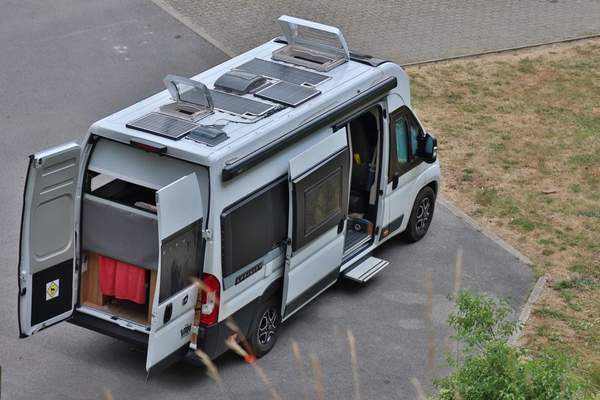
What does a camper solar panel kit need?
A camper solar panel kit needs panels, a suitable charge controller, safe cabling and protection, plus a battery if you want power after dark. Size the camper solar panel kit around what your appliances actually use each day, then make sure the controller, battery and wiring can safely handle the chosen array.
Off-grid solar is easier to size when you start with the loads rather than the roof. Work out what you need to run, how many watts each item uses and how many hours it operates, then build the system around that daily energy requirement.
Definition: A camper solar panel kit is a group of components that turns sunlight into electricity, controls how that electricity reaches the leisure battery and makes the stored energy available for the camper’s electrical loads. The panel wattage alone does not tell you whether the complete system is large enough.
A complete solar panel kit therefore needs to be treated as a system rather than a single panel. The panel, controller, battery, cable sizes, fuses and expected loads all have to make sense together.
What should a camper solar panel kit include?
At minimum, the system needs a solar panel, charge controller, correctly sized cables and appropriate electrical protection. If you want to use solar energy when the panels are producing little or nothing, you also need suitable battery storage.
The solar panel is the generating part. Its rated output tells you its maximum nominal power under specified test conditions, but real output varies with sunlight, temperature, shading, installation angle and the rest of the electrical system.
The charge controller sits between the solar array and the battery. Its job is not simply to connect the two: its voltage and current limits must be suitable for the panel arrangement and the battery system. A controller should therefore be chosen from the electrical specifications of the array, not from the camper’s floor area or the number of berths.
The battery stores energy for times when generation and demand do not happen together. That matters in a camper because cooking, lighting, charging devices and refrigeration can continue after sunset or while the vehicle is parked in shade.
- Solar panel: generates electricity when suitable light reaches the panel.
- Charge controller: manages energy moving from the solar array towards the battery.
- Leisure battery: stores energy for later use.
- Cables and connectors: carry current between the components and must suit the electrical design.
- Fuses or other protection: protect the wiring and equipment where the system design requires them.
- Mounting hardware: keeps the panel securely fitted in the position intended by the installation design.
A packaged solar panel camper kit can make purchasing simpler, but the word “kit” does not guarantee that every component is correctly sized for your particular battery or loads. Check the electrical ratings rather than assuming all parts are interchangeable.
If your camper uses a 12 V leisure system, a 12v solar panel kit may be the natural starting point, but the panel’s own operating voltage will not necessarily be 12 V. The controller has to be compatible with both the array and the battery system.
How much solar power does a camper need each day?
Start by calculating the energy your camper actually consumes in a normal day. Add each appliance’s consumption in kWh, then size the solar system so it has a realistic chance of replacing that energy under the conditions in which you expect to camp.
The basic calculation for an appliance is its wattage divided by 1,000, multiplied by the number of hours it runs. A device marked 40 W that operates for five hours would therefore use 40 ÷ 1,000 × 5 = 0.20 kWh. Use the figures from your own equipment rather than copying a generic camper calculation.
Repeat that calculation for lights, refrigeration, water pumps, laptops, phone charging and any other loads connected to the leisure system. Equipment that cycles on and off should be assessed using realistic operating time rather than assuming it draws its full labelled wattage continuously for 24 hours.
Once you have the daily total, you know what the system is being asked to replace. Panel wattage still cannot be converted into a guaranteed daily kWh figure without knowing the available sunlight, shading and system losses, so a fixed rule such as “one panel is enough for two people” is not reliable.
This is also why a solar panel kit camper should not be selected only by the number printed on the panel box. Two campers with the same array can have very different results if one runs little more than lights and charging while the other expects refrigeration and several other loads to operate throughout the day.
How large should the battery be for camper solar?
The battery needs enough usable stored energy to cover the periods when your loads continue but the solar panels are not replacing that energy. Base the calculation on your measured or calculated consumption, not simply on the size of the solar array.
Battery capacity is often shown in amp-hours, while appliance consumption is easier to understand in watt-hours or kWh. For a nominal 12 V calculation, 1 kWh is 1,000 Wh, and 1,000 Wh ÷ 12 V is about 83.3 Ah before allowing for the battery’s usable capacity, conversion losses or operating limits.
That arithmetic is useful for understanding scale, but it is not a licence to drain every battery to its theoretical maximum. The usable amount depends on the battery specification, its battery-management system where fitted, the electrical loads and the manufacturer’s operating limits.
A practical sizing exercise therefore starts with three questions:
- How many kWh do you normally use between charging opportunities?
- How long must the camper keep operating with poor or zero solar generation?
- What usable capacity does the battery manufacturer actually specify?
If you want the panel and storage supplied together, a solar panel kit with battery can reduce the number of separate components you have to source. You should still verify that the controller ratings, battery voltage and expected loads match rather than assuming a bundled system is automatically suitable.
Can a camper solar kit run a fridge overnight?
Yes, provided the battery contains enough usable energy for the fridge’s actual overnight consumption and for anything else running at the same time. The solar panel itself is not what powers the fridge through darkness; the stored energy in the battery does that job.
To check your own setup, find the fridge’s electrical consumption information and establish how long it actually draws power during the overnight period. Use wattage ÷ 1,000 × operating hours to convert the load to kWh, then add the consumption of lights, pumps, chargers and other equipment that may use the same battery.
Do not assume the compressor runs continuously just because the fridge remains switched on. Equally, do not assume a quoted low consumption figure will apply in every camper. Internal temperature, ambient temperature, ventilation, door opening and the appliance’s own controls can change how often it needs to run.
The important distinction is between generation and storage. During useful daylight the array can recharge the battery while supplying active loads. Overnight, or whenever the panels are heavily shaded, the battery has to carry those loads until useful generation returns.
This is particularly important with a camper van solar panel kit: a roof covered with panels can still leave you short of overnight energy if the leisure battery is too small for the load you expect it to support.
What changes in winter or shaded campsites?
Available solar energy becomes less dependable when daylight is limited or a panel is shaded. Your electrical demand may stay similar while the time available for meaningful charging falls, so the system needs more careful energy management.
Trees, nearby vehicles, roof equipment and the camper’s parking position can all reduce the light reaching a panel. You cannot correct that by looking only at the panel’s rated wattage, because the rating describes the panel under defined test conditions rather than guaranteeing that output on your pitch.
Winter creates another problem: the battery may have to bridge longer periods between useful charging opportunities. That makes an accurate load calculation more valuable, not less. If your daily requirement is known in kWh, you can see which loads are essential and which can be reduced when incoming solar energy is poor.
For regular off-grid use, plan around the conditions in which you will actually travel. A system designed around bright, unobstructed summer days can be disappointing if most of your trips involve winter touring, tree-covered campsites or several days parked without moving.
The same reasoning applies if you are considering a fixed-size kit such as a 200w solar panel kit. The wattage describes the array’s rated power; it does not guarantee a particular daily energy yield in every season and location.
When does camper solar not work as neatly as the photographs suggest?
Camper solar works badly when the installation has been chosen around available roof space while the actual electrical demand has been ignored. A large-looking panel does not fix a battery that is too small, a controller that is incorrectly rated or a daily load that regularly exceeds what the system can replace.
The tidy photographs also assume open sunlight. Real campsites have trees, roof vents, aerials, neighbouring vehicles and pitches where you cannot choose the ideal direction. A camper parked for comfort in summer shade may be parked in a poor position for solar generation. Winter touring makes the gap wider because the system can spend longer relying on stored energy.
It also stops being a sensible DIY job when you cannot confidently verify the electrical ratings, cable protection, battery requirements and installation instructions. A badly designed low-voltage system can still create serious electrical and fire risks. If the work is beyond your competence, use a suitably competent installer rather than copying a wiring photograph or assuming matching plugs mean matching equipment.
Frequently asked questions
Does a camper solar system need a leisure battery?
You need energy storage if you expect electrical loads to continue when the panels are not producing enough power. Without suitable storage, solar generation is available only when the system is producing usable energy at that moment.
Can I add another solar panel later?
Only if the controller, wiring, protection and battery arrangement can accommodate the changed array. Check the controller’s permitted solar voltage and current and the manufacturer’s installation limits before adding panels.
Should I size solar from the camper’s battery capacity?
Battery capacity is part of the calculation, but your actual energy use should come first. Knowing the daily load helps you decide how much generation and storage the camper needs instead of selecting parts solely because they are commonly sold together.
What happens when the battery is full?
The charge controller manages charging according to the battery system and its configured charging requirements. The exact behaviour depends on the equipment, so follow the controller and battery manufacturers’ instructions rather than bypassing their controls.
Can camper solar replace mains hook-up completely?
It can support fully off-grid use only when your generation and usable battery storage are sufficient for your actual loads and camping conditions. Someone with modest electrical demand will have a very different requirement from someone trying to run several higher-demand appliances.
The useful way to choose a camper solar panel kit is to work backwards from your daily electrical demand. Calculate the loads in kWh, decide how long the battery must support them without useful sunlight, then choose panels, storage and control equipment whose specifications fit that requirement.
That approach is less tidy than choosing a kit by panel wattage alone, but it gives you a system based on what your camper actually has to do. Check manufacturers’ electrical limits carefully, and use a competent installer where the design or installation is beyond your experience.