
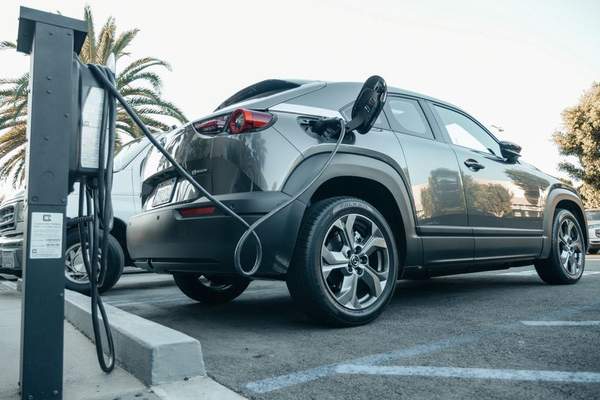
Can I use an ev charging cable extension safely?
An ev charging cable extension is not usually the safest way to gain extra reach. A purpose-made longer charging cable, moving the car closer, or having a chargepoint repositioned by a competent installer avoids extra plug-and-socket joints that can add heat, weather exposure and connection problems during long charging sessions.
Extra reach sounds simple, but EV charging can hold a high electrical load for hours at a time. The safest answer is usually to remove unnecessary connections rather than add another lead between the charger and the car.
The energy calculation is 7,400 W divided by 1,000 = 7.4 kW, then 7.4 kW × 2 hours × 24.5p/kWh = 362.6p a day. At an assumed two hours of charging every day for 365 days, that is £1,323.49 a year at 24.5p/kWh under the July 2026 cap. Your actual figure depends on how many kWh the car takes, so replace the two-hour assumption with your own charging time.
Can an EV charging cable be extended safely?
It can only be considered safe where every component is specifically designed, rated and approved for that use, but adding an extra connection is still less straightforward than using one correctly sized cable. For most homes, a single longer lead or a better chargepoint position is the cleaner approach.
A charging cable is part of a system that includes the car, the chargepoint or portable charger, its plugs, its control equipment and the household electrical installation. An ev charging extension cable adds another connection that must remain mechanically secure, electrically suitable and protected from water, dirt and accidental damage for the whole session.
Check the vehicle and charger manufacturer guidance first. If the instructions rule out an extension arrangement, do not try to make a different cable fit the job.
- Prefer one cable that reaches without tension across the plugs.
- Keep connectors out of standing water and away from places where tyres or doors can crush them.
- Do not join multiple leads together to gain still more distance.
- Have fixed chargepoint changes handled by a competent electrician or approved installer rather than altering wiring yourself.
For a replacement lead, start with the connector type and current rating. The ev charging cable guide is the useful starting point because length only matters after compatibility is correct.
What is the difference between an EV extension and a longer charging cable?
An extension arrangement adds a connection between the original charging equipment and the vehicle, while a longer charging cable provides the needed reach as one purpose-made lead. Fewer plug-and-socket interfaces generally mean fewer places for poor contact, contamination or physical damage to develop.
A ev charge cable extension can look tidy in a product photograph. A real driveway adds rain, grit, kerbs, pedestrians, garage doors and the possibility that a connector sits where a wheel will pass.
| Charging consideration | EV extension lead | Longer EV charging cable |
|---|---|---|
| Number of cable joints | Adds another plug-and-socket connection | Uses one continuous vehicle charging lead |
| Exposure outdoors | Extra joint must be kept suitable for the location and protected from damage | Fewer separate connection points along the route |
| Manufacturer compatibility | Must be explicitly suitable for the car and charging equipment | Can be selected to match the required connector type and rating |
| Cable management | More cable and a joint may need positioning during every session | One lead is simpler to route and store |
| Best use case | Only where the equipment maker permits the arrangement and the product is intended for it | Where regular extra reach is needed without adding an intermediate connection |
If parking regularly needs more reach, a long ev charging cable avoids building a chain of connections. A 10m ev charging cable may be enough where it matches the car, chargepoint and manufacturer requirements.
Why can ordinary extension leads be risky for EV charging?
Ordinary household extension leads are not automatically suitable for repeated EV charging because the load can be high and sustained for many hours. Heat can build at plugs, sockets, cable reels and poor connections, especially if equipment is damaged, undersized, coiled, wet or used outside its intended conditions.
A typical 3-pin portable EV charger may draw about 2,300 W, so the demand is not comparable with briefly powering a lamp or phone charger. At 24.5p/kWh under the July 2026 cap, 2,300 W divided by 1,000 gives 2.3 kW, and 2.3 kW × 1 hour × 24.5p/kWh = 56.35p for one hour of charging. That figure is for one hour only, not an annual estimate.
The weak point is not the cable length alone. A worn socket, loose plug, poorly protected outdoor joint or coiled reel can create heat. An ordinary extension cable for ev charging is not safe merely because the plug fits.
If a portable 3-pin charger is the only practical arrangement available, follow the car and charger maker’s instructions exactly and have any doubtful socket or circuit assessed by a qualified electrician. Do not improvise weather covers, adapters or multi-plug arrangements as substitutes for equipment intended for EV charging.
What should I do if my charging cable cannot reach the car?
Start by changing the layout before buying anything: park within the cable’s intended reach and make sure the lead is not stretched, trapped or routed where it will be driven over. If that does not solve it, move to a longer compatible cable or ask an installer whether the fixed chargepoint can be repositioned.
For a regular home setup, use an arrangement that works without special handling. If you must wedge a connector under a gate or leave a joint in the rain, the charging position needs a better solution.
Use the simplest permanent arrangement
- Choose a longer single EV charging lead that matches the vehicle and chargepoint specification.
- Reconsider the parking orientation if reversing into the space puts the charge port within easy reach.
- Ask a competent installer whether the chargepoint can be moved to a position that serves the parking space without tension on the cable.
- Use a cable holder or storage point so the longer lead is kept off the ground when it is not connected.
A longer lead also makes it easier to inspect one cable for cuts, crushed sections and damaged plugs. Extra reach is useful only if it can be routed without creating a trip hazard across shared space.
When does a longer cable still not solve the problem?
A longer lead is not a cure for a bad parking layout, a tenancy restriction or a cable route that crosses land you do not control. In a rented home, the landlord may decide whether a wallbox can be installed or moved, and you should not alter fixed wiring without permission. In a flat, the parking bay may be too far from your meter position, or the route may cross a communal path where a loose cable creates an obstruction.
Some solutions work only in a photograph: a perfectly straight lead across an empty drive, a connector kept dry by good weather, or a cable that never meets a wheel, gate or pavement. Real homes have visitors, bins, children, rain and changing parking positions. If the only way to reach the car is to run cables through a window, across a public footway, through standing water or under a closing door, do not normalise that layout. The right answer may be a different parking position, landlord agreement, or a professionally repositioned chargepoint.
Frequently asked questions
Can I join two Type 2 charging cables together?
Do not assume two Type 2 leads can be joined simply because the connectors appear compatible. Use only arrangements explicitly intended and approved for the vehicle and charging equipment, because an extra connection changes the mechanical and environmental risks.
Is a 10 metre EV charging cable too long for home use?
Not if the cable is correctly specified for the car and chargepoint and can be routed without being stretched, crushed or left as a trip hazard. The useful length is the shortest one that reaches comfortably from the charging point to the vehicle in its normal parking position.
Can an EV charging cable be left outside in the rain?
Purpose-made EV charging equipment is designed with defined environmental ratings, but plugs and connectors still need to be used exactly as the manufacturer specifies. Do not assume a separate extension joint has the same protection as the original charging system.
Should I move my wallbox if the cable is always stretched?
If the lead is routinely pulled tight, trapped by the car or routed unsafely, ask a competent installer to assess the chargepoint position. Moving fixed charging equipment is electrical work and should not be treated as a DIY cable-length problem.
Does a longer EV cable make charging slower?
A correctly specified charging cable should be chosen to carry the required current for the vehicle and chargepoint. If you are unsure about a cable’s rating or compatibility, check the equipment documentation or ask the manufacturer before relying on it for regular charging.
An ev charging cable extension can add reach, but it also adds another connection that has to remain suitable for a demanding, long-duration electrical load. For a repeatable home setup, one correctly specified longer cable or a better-positioned chargepoint is usually the more straightforward answer.